Export-Limited Solar Projects: Specify BESS Control Before Adding Capacity
Export-limited solar battery storage needs a defined control response when the battery is full, unavailable or unable to charge fast enough. Adding nominal kWh can increase the time available to absorb solar energy, but it does not by itself enforce a limit at the grid connection. The project must coordinate measurement, battery charging and PV curtailment.
The EPC should write that control requirement before comparing storage sizes. It needs to cover the normal sunny-day condition and the states in which storage cannot absorb the surplus. The examples below use hypothetical site values to explain the power balance. They are design illustrations, not utility-approved settings or measured project results.
Key Takeaways
- Apply the export limit at the agreed point of connection.
- Size charge power and energy headroom separately.
- Test full-battery, lost-meter and lost-communications behaviour before accepting the control system.
On this page
- Read the connection requirement literally
- Separate the instantaneous surplus from its duration
- Choose a product boundary that matches the control question
- Full state of charge must be a normal operating case
- Specify failure behaviour with the responsible utility team
- Acceptance should challenge the easy demonstration
- Questions project owners should settle
Read the connection requirement literally
Obtain the utility’s written requirement for export, including its measurement boundary, averaging or response rule, permitted excursions and commissioning evidence. A “zero export” phrase in a proposal is incomplete unless it identifies what is measured and how the requirement is verified. Do not infer the rule from another site’s project.
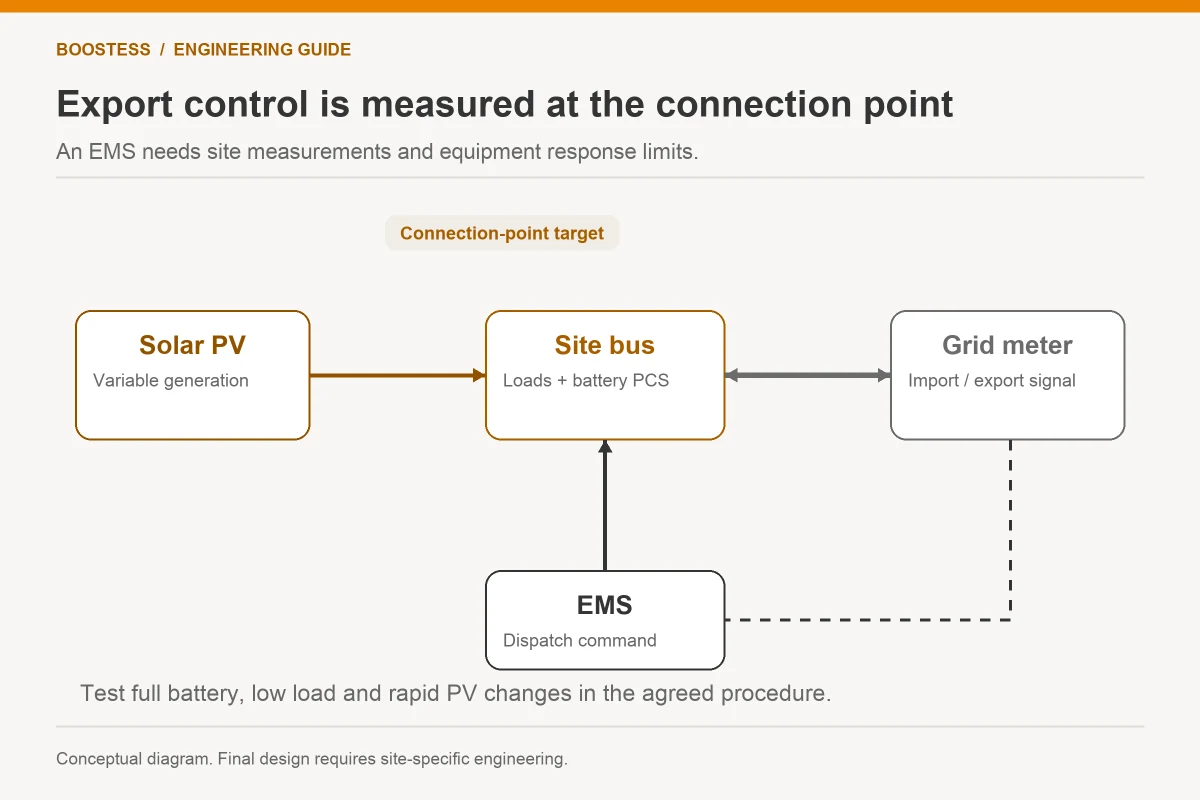
Draw all sources and loads behind that boundary. Include existing PV inverters, new storage, generators where present and any feeder outside the controller’s measurement. A meter placed on the battery feeder cannot measure whole-site export. A meter placed upstream of only some sources may overlook an independent path to the connection.
Agree meter direction, phase mapping and timestamps. Battery charging, discharging and site export must use consistent sign conventions. During commissioning, compare the controller’s reading with an independent approved reference. A sign error can make the controller increase the condition it is supposed to reduce.
The DOE distributed energy interconnection checklist is a useful process reference for utility coordination. It does not grant permission for a particular export controller. The EPC still needs the actual connection conditions and the utility’s acceptance of the offered arrangement.
Separate the instantaneous surplus from its duration
Assume a conceptual site has 450 kW of PV output and 250 kW of load. Without battery charging or curtailment, the surplus is 200 kW. If the permitted export in this example is 100 kW, the site must absorb or curtail another 100 kW while those conditions persist.
A battery capable of accepting 100 kW at the relevant operating state could absorb that power. The required energy depends on duration. Thirty minutes at 100 kW represents 50 kWh entering the charging boundary; two hours represents 200 kWh. The final stored energy differs once the agreed efficiency and auxiliary boundary are included.
A site load reduction changes the problem immediately. If load falls from 250 kW to 150 kW while PV output stays at 450 kW, required absorption or curtailment becomes 200 kW under the same export limit. Extra energy capacity does not make an insufficient charge-power rating larger.
| Hypothetical condition | PV output | Site load | Export allowance | Required absorption or curtailment |
|---|---|---|---|---|
| Normal sunny period | 450 kW | 250 kW | 100 kW | 100 kW |
| Load drops | 450 kW | 150 kW | 100 kW | 200 kW |
| Lower PV output | 300 kW | 250 kW | 100 kW | 0 kW |
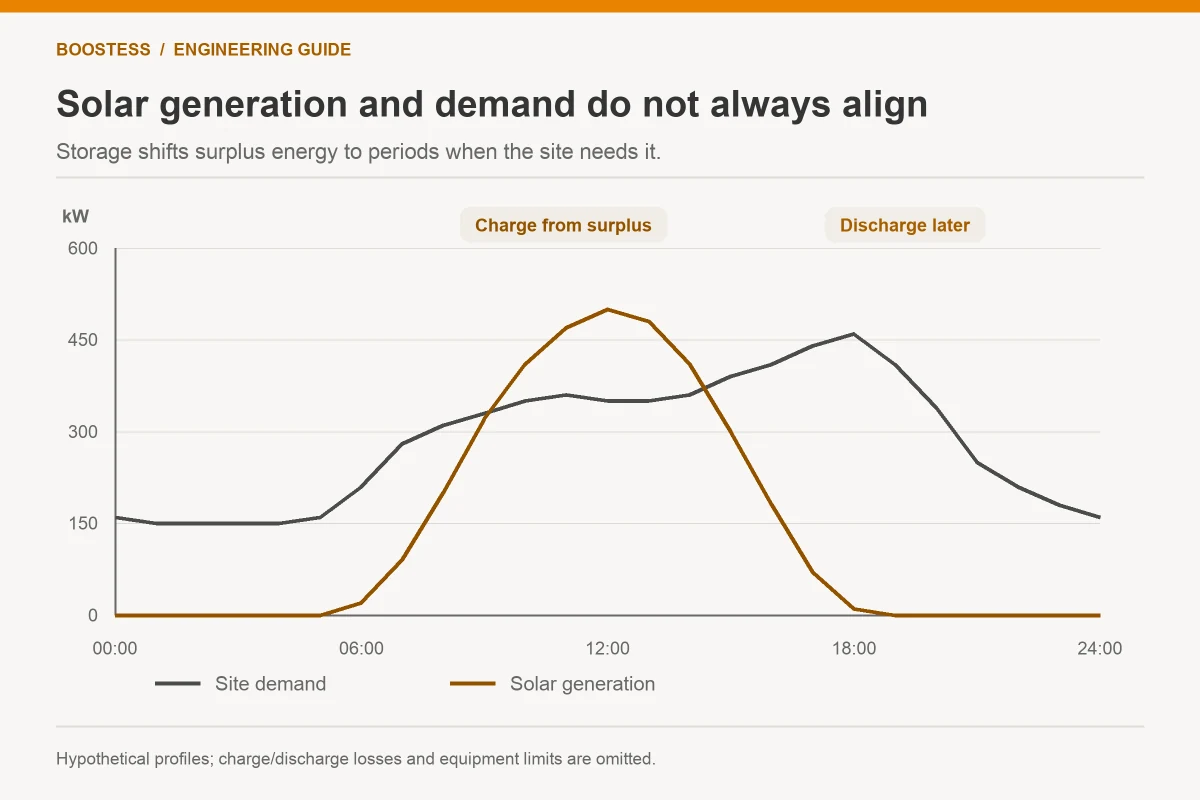
The owner should provide time-series data that captures these transitions. An annual solar surplus figure may estimate energy opportunity, but it cannot establish the controller’s required power response.
Choose a product boundary that matches the control question
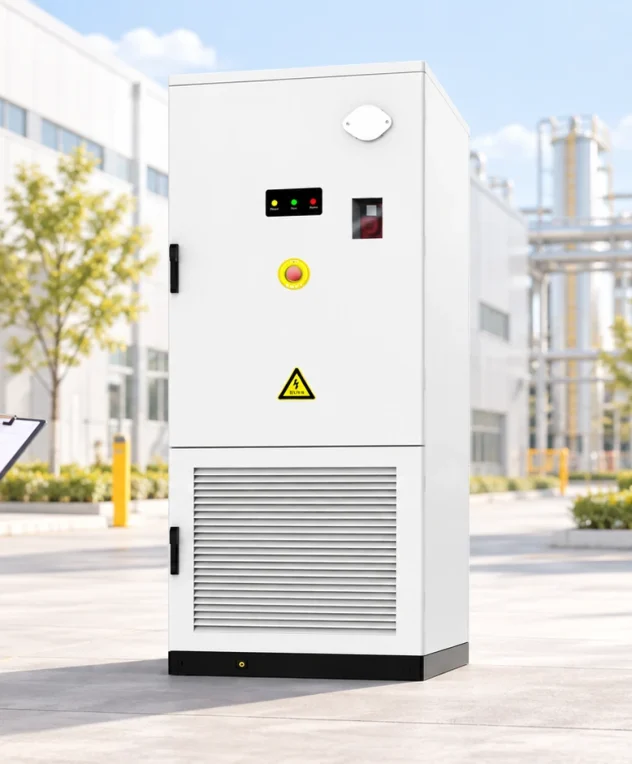
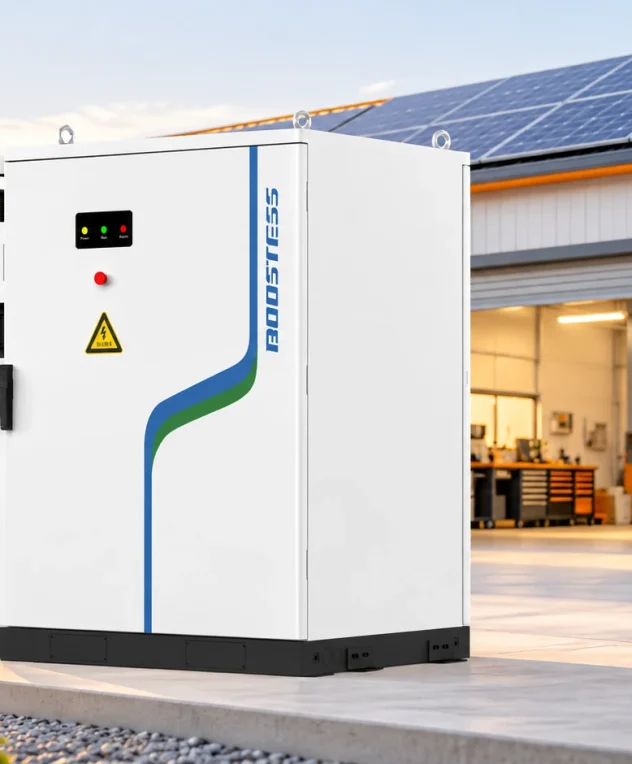
The BOOSTESS brochure describes a 125 kW / 261 kWh liquid-cooled AC cabinet with an integrated PCS, LFP battery storage and communication interfaces. That is a documented architecture to evaluate for the example. Confirm available AC charging power and its conditions; the advertised 125 kW rated output is not, on its own, an export-control guarantee.
Also confirm which equipment can curtail the PV. The cabinet’s storage capacity cannot establish that its controller has authority over an existing PV inverter. Obtain the supported communication interface, approved software versions and the division of responsibility between the site controller and inverter controllers.
Other cabinet types may integrate PV input directly. A solar and battery integration assessment should distinguish that architecture from an AC retrofit with independent PV inverters. Treat connection permission and controller acceptance as project requirements in either case.
Avoid multiplying a cabinet count by its nominal power and calling the result compliant. Parallel operation needs an approved shared control scheme, bus assessment and site measurement. The total available power can change if one unit stops or derates. The export limit still applies to the remaining configuration.
Full state of charge must be a normal operating case
The controller must enforce the agreed export behaviour even when battery charging is unavailable. This can occur at full charge, during maintenance, after a protective stop or under operating conditions that restrict charge power. The project therefore needs another permitted response, typically involving PV control or another approved arrangement.
Use an illustrative energy-headroom calculation. If a conceptual battery has 100 kWh nominal energy and only forty percentage points of nominal charge headroom remain, the simple nameplate headroom is 40 kWh. At a constant 100 kW incoming charging rate, that represents twenty-four minutes before accounting for the actual SOC calibration, losses or operating boundaries. It is not an equipment duration guarantee.
The calculation shows why headroom can disappear during a long sunny interval. A daily schedule should create room where the economics and reserve policy permit it. Yet an economic preference to discharge earlier cannot become the only protection against excessive export. Forecasts can be wrong, and an outage reserve may prevent the desired discharge.
The discussion of reducing solar curtailment with batteries explains the broader energy opportunity. In an export-limited project, retain curtailment as an explicit controlled state. Some available solar energy may need to be curtailed when charging headroom or site demand is exhausted.
A product-specific worksheet should also distinguish battery headroom from the equipment label. For the documented 261 kWh nominal cabinet, a hypothetical forty-percentage-point headroom would represent 104.4 kWh on a simple nameplate basis. At an assumed 100 kW charge input, that suggests roughly an hour of absorption before losses and actual operating limits are resolved. It does not establish guaranteed charging duration. Ask the supplier to replace this arithmetic with the offered configuration’s usable charge window, available charging power and agreed measurement boundary. That evidence shows whether the cabinet covers the site’s surplus interval or merely delays the point at which PV must be curtailed.
Specify failure behaviour with the responsible utility team
List the measurements and communication links required by normal control. Then define what happens if each becomes stale, disconnected or inconsistent. The selected fallback should meet the actual connection agreement and the approved protection design. It should not depend on a remote operator noticing the problem in time.
A meter-loss scenario needs a command timeout, an alarm and a defined response from both battery and PV equipment. A cloud dashboard becoming unavailable is a different event from losing the local connection meter. Keep those cases separate so the acceptance test can identify which function remains available.
Reconnection needs rules too. When communications return, the controller should reconcile current source output, load, SOC and active limits before resuming normal dispatch. Stale commands and old forecasts should not silently become live instructions. Specify how the operator can see the transition and any unresolved alarm.
The IEA grid modernisation executive summary places flexibility and connection planning in a broader system context. It does not establish a universal permissible response time for site export. Keep numeric limits and test tolerances traceable to the local project documents.
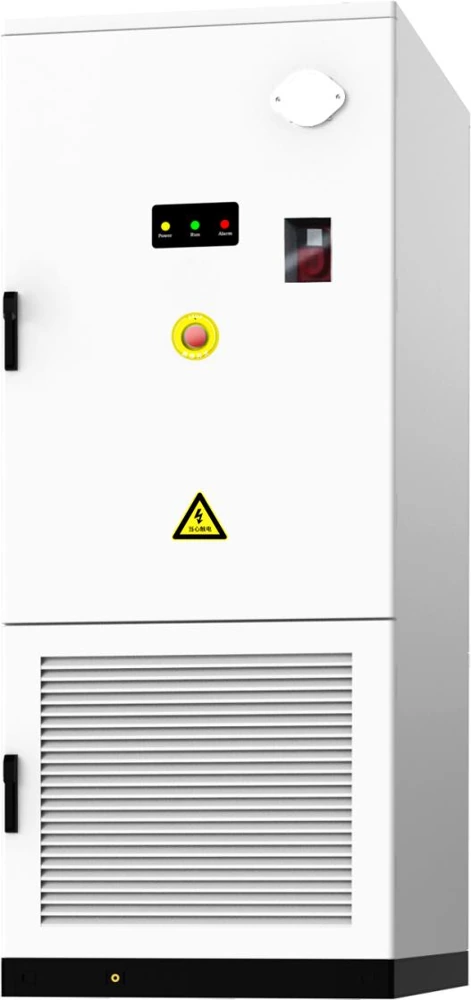
Confirm whether the proposal supplies a complete AC cabinet or a DC battery cabinet with separately selected conversion equipment. Their energy labels can be similar while control ownership and charging interfaces differ. The export test must cover the complete installed arrangement, including the actual PCS or hybrid inverter and the controller that commands the PV.
Acceptance should challenge the easy demonstration
A midday demonstration with a partly empty battery shows only one operating state. Include agreed tests for a sudden site-load decrease, rising PV output, restricted battery charging, full charge, one storage unit unavailable and lost measurement. Use approved test methods and respect the site’s connection conditions throughout the programme.
Record power at the point of connection, PV output, battery AC power, charge availability, SOC, controller commands and alarms on a common time base. Define the duration and magnitude of any permitted excursion before testing. Otherwise the team may disagree afterward about whether a brief export event constitutes a pass.
The test report should identify the equipment and firmware revisions, active setpoints and measurement configuration. Retain that configuration at handover. An export function tested with one meter placement or software version cannot automatically be assumed valid after either changes.
Require a change-review process for PV expansion, new loads and replacement inverters. A load added today can make export control easier during normal operation, but its sudden disconnection may make the worst case more demanding. Review both directions of change instead of assuming that more load always reduces the storage requirement.
Questions project owners should settle
Does more battery capacity remove the need for PV curtailment?
It can increase absorption duration when power and headroom permit. It cannot guarantee that storage will always be available or empty enough. Define the full-battery response and obtain approval for the complete control arrangement.
Is an inverter’s export setting sufficient?
That depends on the measurement boundary, number of sources and utility requirements. A setting on one inverter may not control the entire site’s net export. Verify coordinated operation with all relevant equipment.
What belongs in the storage request for quotation?
Include the written export conditions, one-line diagram, existing PV details, load data, reserve policy, charge-power requirements and failure-state acceptance tests. Ask the bidder to disclose supported interfaces and exclusions. This turns “export limited” from a marketing phrase into an engineering deliverable.