Commercial BESS Acceptance: Test Grid, Backup and Recovery Modes
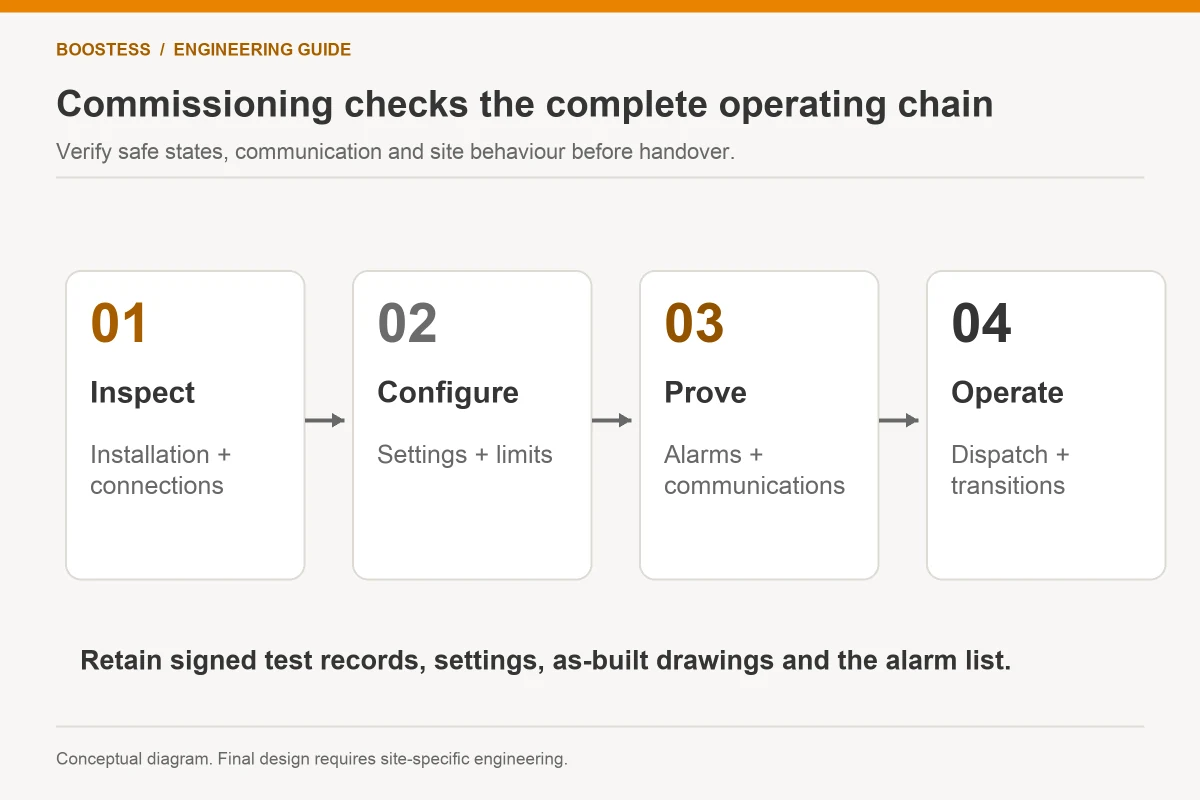
Commercial BESS acceptance should prove the installed functions in grid operation, backup operation and recovery. Define the expected behavior before testing: which loads are supplied, what limits apply, how the controls respond to a fault and what records establish the result. Electrical inspection and a powered dashboard are necessary parts of the project, but neither demonstrates every operating commitment.
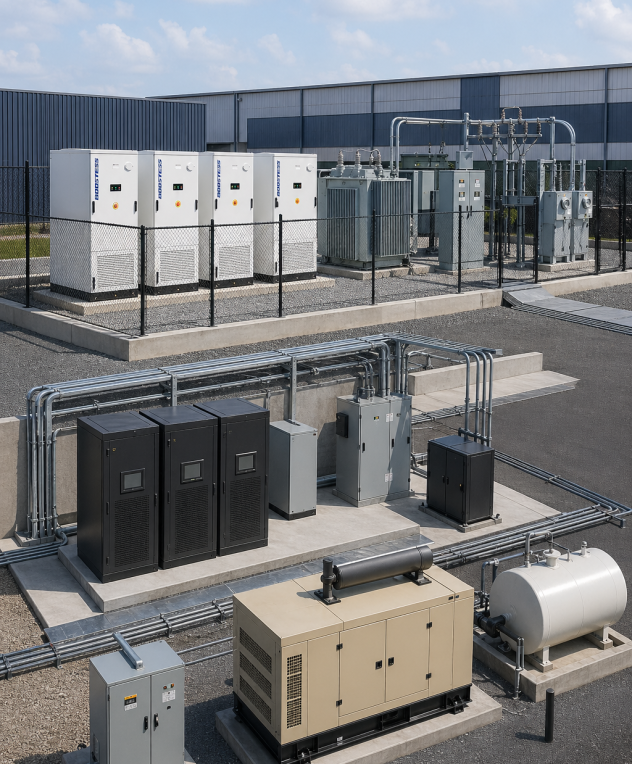
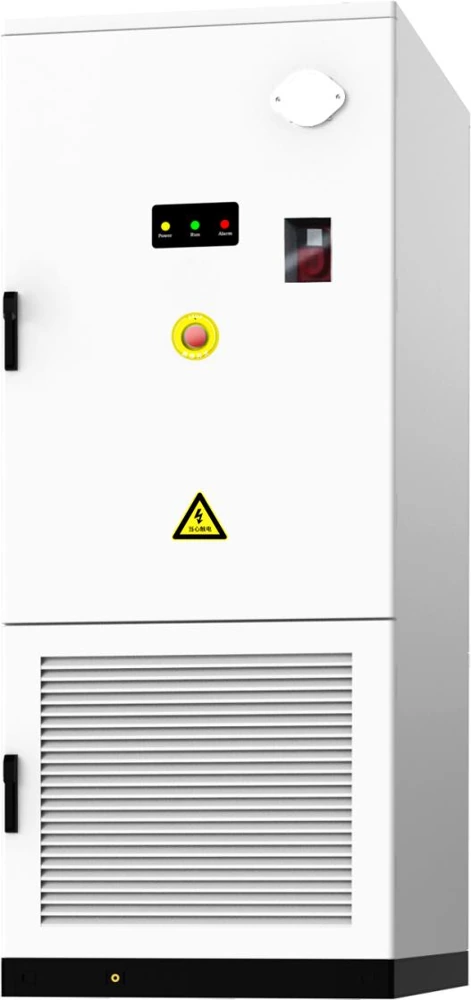
Begin with the actual ordered architecture. The 50kW/100kWh hybrid system, 105kW/241kWh integrated cabinet and 125kW/261kWh integrated cabinet require a functional plan matched to their documented configurations. A separately supplied DC battery cabinet introduces an external PCS or hybrid inverter and a different integration boundary.
This article provides a test-planning structure for owners and engineers. The responsible professionals must write and perform the actual procedures using manufacturer instructions, approved safety controls and project permissions.
Key takeaways
- Translate each operating promise into an observable acceptance result.
- Test faults and recovery as well as normal operation.
- Keep model identity, firmware and measured data in the handover record.
On this page
- Agree on the installed configuration before writing tests
- Start with owner requirements that can be observed
- Test grid-connected control as a complete sequence
- Define usable-energy acceptance at one meter boundary
- Check backup operation with the approved loads
- Include communications loss and unavailable equipment
- Observe recovery, recharge and return of dispatch
- Use a test matrix with clear closure rules
- Keep the handover useful after commissioning
- Questions about site acceptance
- Accept the demonstrated operating commitments
Agree on the installed configuration before writing tests
An acceptance plan needs a frozen equipment record. Identify battery configuration, PCS or inverter model, EMS version, protection arrangement, communications interfaces and auxiliary supplies. Include the relevant drawing and document revisions.
This record prevents a test from demonstrating one arrangement while the contract describes another. For example, the supplied 261kWh DC cabinet is rated as a battery system and requires compatible external conversion equipment. The supplied integrated 125kW/261kWh unit includes a specified AC power rating. They should not share an acceptance schedule that assumes the same conversion boundary.
The DOE BESS technical specifications calls for documented operating sequences and commissioning. It is an editable procurement template rather than a universal procedure. The practical requirement for this project is to connect every tested function to the configuration and documents that define it.
Start with owner requirements that can be observed
List the owner’s operating requirements in plain terms. These may include an import cap, a defined peak-management window, a usable-energy delivery, selected backup loads or a controlled source transition. Avoid accepting statements such as “intelligent dispatch” without specifying the behavior they mean.
For each requirement, identify an input, an expected response and the record that proves it. An import-cap test needs site import measurement and controller behavior. An energy-delivery test needs an agreed meter boundary and initial conditions. A backup test needs the actual load identities and acceptable supply conditions defined by the approved design.
Also identify what is outside the commitment. A test of selected essential circuits does not demonstrate supply to the complete factory. A test at one ambient condition does not establish power across an undocumented temperature range. Record these boundaries in the acceptance report so later operators understand what was demonstrated and what still depends on equipment limits.
Test grid-connected control as a complete sequence
Grid operation includes charging, discharging and response to site measurements. Review meter orientation, signal quality and the controller’s interpretation of import and export. An incorrect or stale signal can affect the entire dispatch strategy.
A functional test should demonstrate the agreed control objective and its constraints. For a peak-management application, the approved plan can check battery response to a representative site demand condition, the available SOC range and the subsequent recharge behavior. The specific method must be designed for the installation rather than improvised during acceptance.
Include operation at the agreed power limit. The supplied 105kW/241kWh unit lists 105kW rated AC power, while the liquid-cooled integrated unit lists 125kW. A request for 140kW from one unit would require a separate approved capability; nominal energy cannot establish that output. Test requests must remain within the accepted equipment conditions and the utility connection arrangement.
Define usable-energy acceptance at one meter boundary
The energy test should specify measurement point, power, SOC window, ambient conditions and treatment of auxiliaries. It should also state how the starting and ending conditions are established. Otherwise, two parties can report different results from the same test.
The DOE BESS evaluation method uses metered charge/discharge records for performance assessment. For site acceptance, use an agreed test method and calibrated records appropriate to the contract. Do not substitute a dashboard’s estimated SOC change for the contracted delivered-energy measurement without an approved method.
A hypothetical test at 40kW for one hour requires 40kWh delivered at the stated boundary. That arithmetic does not establish whether a 100kWh nominal system passes its overall energy requirement. The test only demonstrates the selected operating period and conditions. If the contract calls for a larger usable-energy delivery, write a test that covers that actual obligation.
Check backup operation with the approved loads
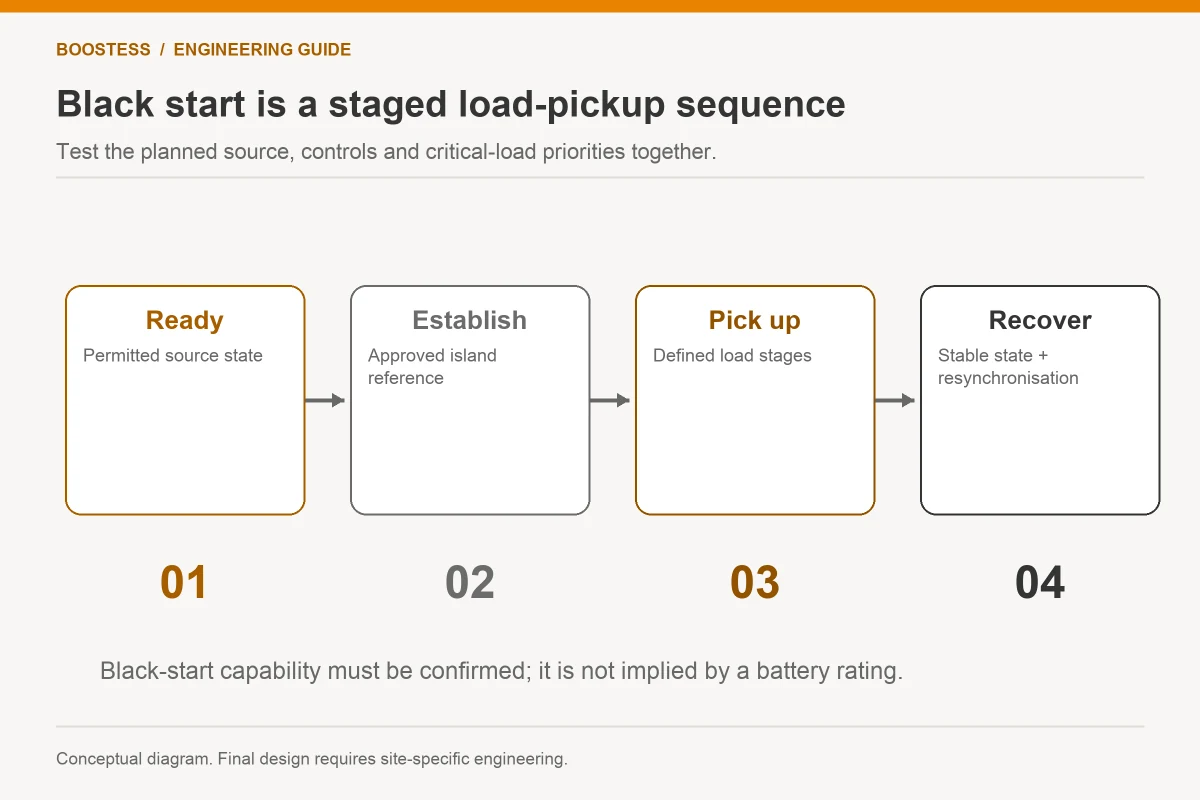
Backup acceptance should use the approved load groups and operating sequence. Identify which circuits remain supplied, which are disconnected and what happens if available energy becomes insufficient. Include any generator or other source participating in the design.
Do not assume that a fast transfer figure guarantees uninterrupted operation of arbitrary equipment. Loads differ in their tolerance and startup behavior. The responsible engineer should connect the inverter’s documented performance with the actual loads and the owner’s requirement. Where another UPS remains in the system, its role belongs in the boundary drawing.
The DOE microgrid checklist treats the commercial microgrid as an integrated project. For this acceptance plan, that means observing the source, controls and connected loads together. A battery test with the site loads disconnected cannot by itself prove the promised backup function for those loads.
Include communications loss and unavailable equipment
The installation needs an agreed response when a required signal or component becomes unavailable. Review loss of site-meter data, loss of remote connectivity, a BMS limitation and PCS unavailability. The engineer decides which simulations are safe and suitable for the approved test.
Specify the expected local behavior and alarm. A disconnected internet connection may affect remote monitoring while local protective control continues, but that outcome must be documented and verified for the offered arrangement. Protocol names such as Modbus, CAN or MQTT do not establish the behavior during a fault.
The test record should show what failed, what the system observed, what it did and how the operator was informed. Identify whether intervention requires a qualified technician or an authorized user action. Avoid treating a fault alarm as successful acceptance if the underlying control response has not been checked against the agreed sequence.
Observe recovery, recharge and return of dispatch
Recovery should restore the intended operating policy. After an outage or test event, confirm how the system returns to grid operation, replenishes reserve and resumes normal dispatch. Check that temporary test settings and permissions are removed or formally accepted.
Recharge can create another site constraint. A controller may need to replenish the battery while keeping import within an agreed limit. The acceptance plan should observe that conflict under approved conditions rather than test discharge alone. An energy-management function includes how the system prepares for the next event.
Record remaining alarms, controller state and battery reserve at the end of each test. An installation can appear operational while a latched condition prevents the next scheduled function. The owner needs a clear completed state and the authorized recovery procedure. The acceptance report should not end with a note that the commissioning team will return later to explain those details.
Use a test matrix with clear closure rules
The following is an illustrative structure for the project team to adapt. It does not set universal pass values.
| Operating condition | Expected function to define | Evidence to retain |
|---|---|---|
| Grid connected | Approved charge/discharge and connection limits | Meter records, commands and controller state |
| Backup | Supply to agreed load groups | Load status, source response and reserve record |
| Communications fault | Approved fallback and alarm behavior | Event timestamps, alarms and final state |
| Source unavailable | Defined limitation or alternate-source response | Source status and load-priority record |
| Recovery | Return to agreed operation and recharge policy | Final settings, alarms and operating data |
Set a closure rule for every exception. A failed result should have an assigned cause review, corrective action and retest requirement. A test omitted because of site conditions needs an explicit decision about deferred acceptance. Do not bury unresolved functional obligations in an undifferentiated punch list of minor construction items.
Keep the handover useful after commissioning
The handover should connect test results with normal operation. Include final drawings, equipment identities, firmware, approved settings, operating procedures and training records. Keep data files in a form that another engineer can interpret.
Time alignment matters when several devices report events. Define timestamp handling, recording intervals and signal names before testing. Retain the measurements needed to reconstruct the event, rather than only screenshots of the final dashboard. Mark which readings are measurements and which are calculated or estimated values.
Finally, establish who can change the accepted configuration. A firmware update, revised reserve policy or added load can alter the function that was tested. The owner should have a process for reviewing such changes and determining whether further verification is required. Acceptance evidence remains useful only when it can be connected to the current installation.
Questions about site acceptance
Is a factory acceptance test enough?
It can verify the supplied equipment within its factory test scope. Site acceptance addresses installation-specific wiring, meters, source interfaces and loads. The two records serve different purposes and should be connected.
Can one successful backup event close every test?
No. It demonstrates the conditions used in that event. Grid controls, communications faults, energy delivery and recovery need their own agreed evidence where they form part of the project commitment.
Should the owner keep raw operating data?
Yes, when it supports the acceptance method and future investigation. Define available signals, format and retention in the scope so that event records remain interpretable after handover.
Accept the demonstrated operating commitments
Final acceptance should identify the functions proved, the conditions used and any unresolved requirements. It should give the owner a complete operating record for the installed configuration. This makes acceptance a practical decision about delivered behavior rather than a ceremonial handover.
For a project-specific test scope, send BOOSTESS the operating requirements, loads and interface drawings through a technical inquiry. Ask for a functional acceptance plan alongside the equipment selection, with grid, backup and recovery responsibilities clearly assigned.