Microgrid Black Start: Test the Load Pickup Sequence
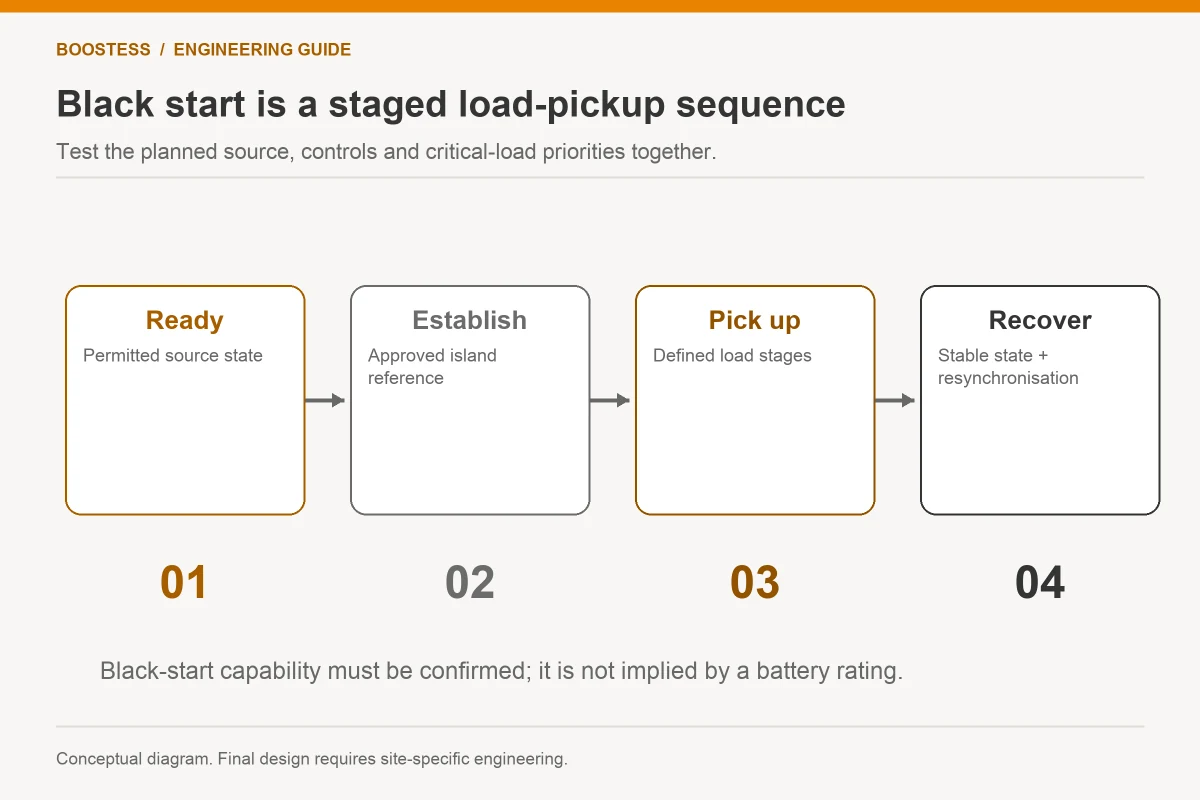
Microgrid black start requires a verified path from a de-energized system to stable supply of the agreed loads. The acceptance question is whether the complete installation can establish control power, start the required sources, pick up loads in the approved sequence and recover from a failed attempt. A battery’s stored energy or fast response does not answer all of those questions.
Define the black-start function before selecting equipment. A hybrid commercial storage system may be part of the architecture, but the offered configuration needs documented operating modes, auxiliary supplies and control responsibilities. A capability associated with one inverter should not be assumed for every cabinet or rack connected to it.
This guide is an engineer-facing test-planning framework. Actual switching, protection settings and commissioning procedures belong in the approved project plan and must be performed by qualified personnel.
Key takeaways
- Separate black start from normal backup transfer.
- Include control power, auxiliaries and load pickup in the test scope.
- Verify failed-start recovery and restoration, not only the successful sequence.
On this page
- Define the starting condition precisely
- Establish who forms the electrical supply
- Include auxiliary power in the black-start boundary
- Divide loads into controlled pickup groups
- Use a sequence matrix with observable results
- Check energy reserve for the full sequence
- Test failure cases without improvising on site
- Verify restoration to normal operation
- Questions for the supplier and integrator
- Request proof of the complete function
Define the starting condition precisely
A black-start test needs a clear initial state. Specify which parts of the site are de-energized, which sources remain available and how control and safety equipment receive power. Also record battery SOC, environmental conditions and the loads expected to remain disconnected until instructed.
Normal backup transfer can begin while controls are already powered and the system is operating. A black start may begin with a different electrical and communications state. Those differences change what must function first. The acceptance document should avoid using “backup,” “islanding” and “black start” as interchangeable labels.
The DOE microgrid basics describes black start as part of restoring supply and matching generation with load. For the project, turn that concept into an explicit boundary drawing. Identify the bus to be energized, the first source, the supporting equipment and the parties responsible for their readiness.
Establish who forms the electrical supply
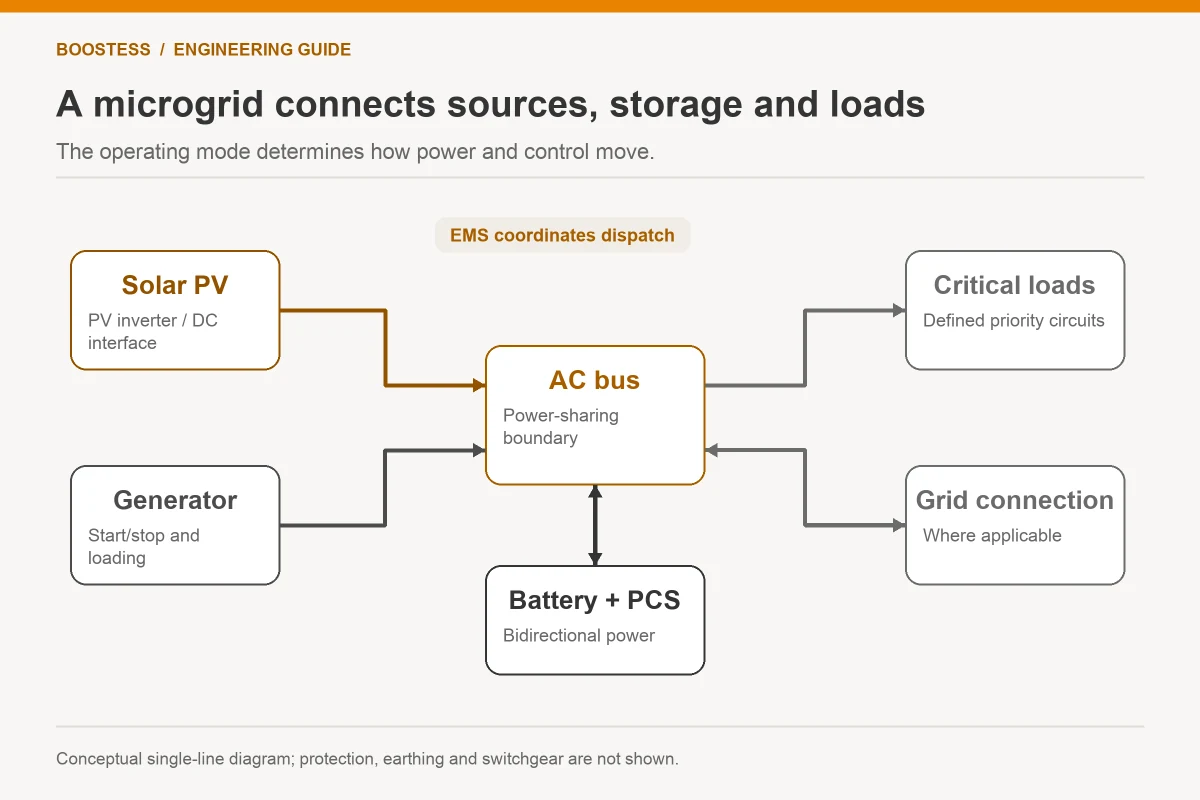
Ask which equipment establishes the islanded supply and which equipment requires an existing supply to operate. Obtain the manufacturer’s documentation for the exact inverter, firmware and configuration. A statement that a system supports off-grid operation should be connected to the intended site arrangement.
The control design must explain how sources and loads are coordinated. Include the battery PCS, generator controls, renewable inverters and any supervisory controller. Communication protocol names alone do not establish the operating sequence. The integrator needs the supported functions, limits and failure behavior at each interface.
Record dependencies. If a renewable inverter requires an energized bus, it cannot be counted as the first source simply because sunlight is available. If a controller depends on an auxiliary supply, identify how that supply starts. The engineer should evaluate these relationships before drafting the test steps. A dependency diagram often exposes omissions that an equipment list does not.
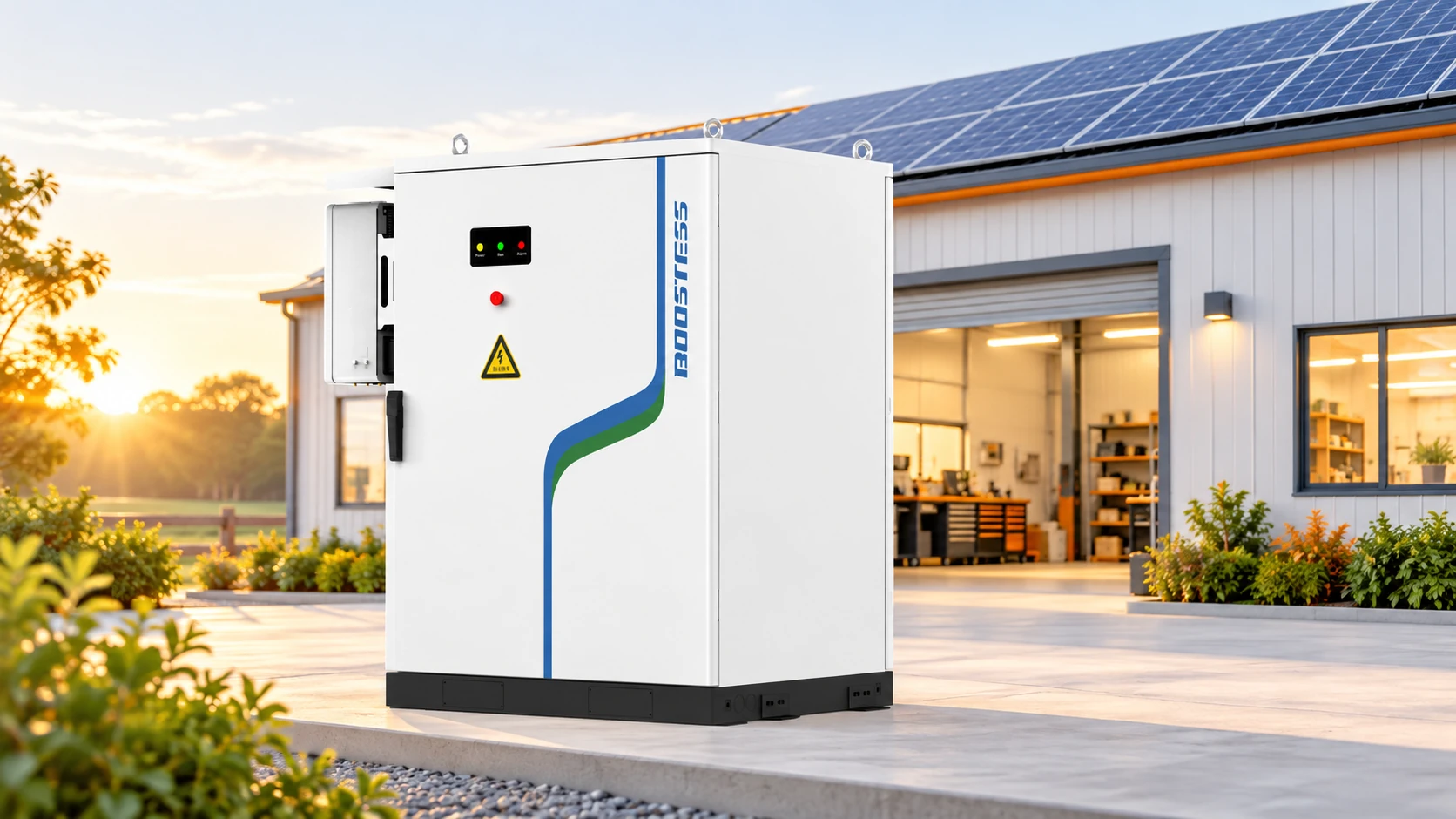
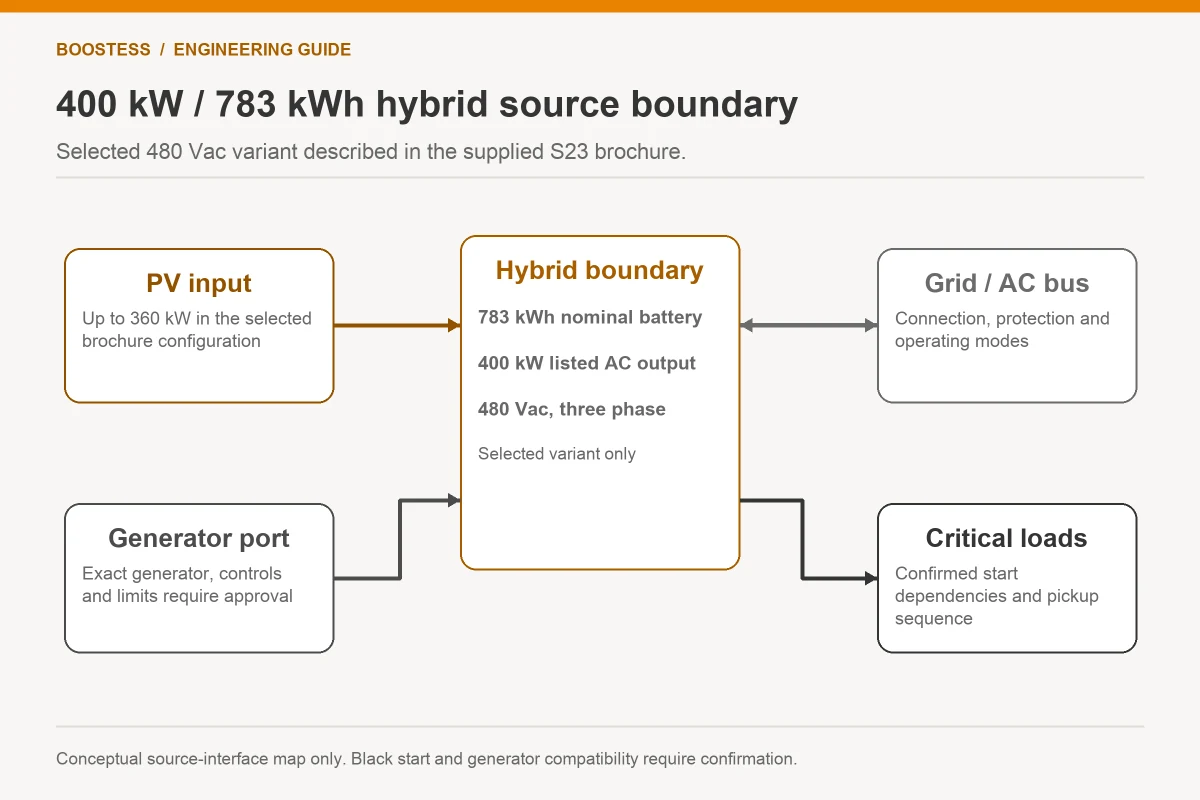
The supplied 400kW/783kWh solar-storage-diesel container includes a diesel-generator port and lists 480Vac three-phase operation for its 400kW configuration. Its PV table specifies up to 360kW PV input, while other voltage configurations have different listed output limits. These details support a discussion of multiple source interfaces; they do not prove black-start behavior. The supplier and integrator still need to confirm the exact source-start dependencies, auxiliary supplies and firmware functions for the selected voltage arrangement. A drawing based on the 400kW variant should not silently apply to a lower-power variant.
Include auxiliary power in the black-start boundary
Controls, contactor supplies, communications, cooling and safety systems can have their own power needs. Identify which must operate before the main output becomes available and which can start later. The battery is only one part of this sequence.
Ask for the auxiliary demand and startup behavior of the offered equipment. Separate continuous consumption from startup requirements. Include any independent supply, its supervision and its endurance under the agreed initial condition. The test plan should establish how an unavailable auxiliary source is detected and reported.
A useful review question is whether the system can begin the approved sequence after a prolonged shutdown, rather than only after a recent grid interruption. The answer may depend on SOC, stored settings, auxiliary batteries or environmental conditions. Do not invent an endurance period. Put the manufacturer’s documented requirements and the site’s operating objective into the plan, then verify that the complete installation meets them.
Divide loads into controlled pickup groups
The first energized load group should be defined by the approved design. Classify essential circuits, controllable circuits and loads that can remain disconnected. For each group, record normal power, startup behavior and its importance to the site’s function.
Motor and compressor loads need more than average-energy figures. Ask the electrical designer to consider starting demand, voltage behavior and the supported inverter overload conditions. A system that supplies the average running load may still require a different pickup arrangement. Existing equipment controls also need review so that multiple loads do not restart unexpectedly at the same moment.
The DOE microgrid project checklist covers planning through implementation. For black-start acceptance, a load register provides the practical connection between those stages. The commissioning team should receive the final circuit identities and approved grouping, not an early estimate describing only “critical loads.”
Use a sequence matrix with observable results
A sequence of operations should describe the intended state changes and how success is confirmed. Include the initiating condition, permitted action, required observation and response when the observation is absent. The matrix below is a proposed documentation format, not a switching instruction.
| Function | Evidence to observe | Question for the approved design |
|---|---|---|
| Control readiness | Controller and safety-system status | What prevents startup when required equipment is unavailable? |
| Supply establishment | Agreed bus measurements and source state | Which device establishes the islanded supply? |
| First load group | Load status and source response | What confirms that pickup stayed within approved limits? |
| Additional sources | Source status and accepted connection | Who authorizes renewable or generator participation? |
| Failed attempt | Alarm, safe state and event history | What is the documented recovery route? |
Each row should point to the relevant drawing or manufacturer instruction. Record who observes the result and how the evidence is retained. If a function depends on a signal exchanged between two suppliers, identify both interfaces and the party responsible for confirming the complete behavior.
Check energy reserve for the full sequence
Black-start reserve must include the agreed startup sequence and subsequent operation. A SOC threshold without a defined usable-energy basis is not enough. Identify the energy needed before another source becomes available and the reserve required if that source fails to start.
Use a hypothetical planning example to make the distinction clear. If an agreed essential load consumes 20kW for 30 minutes, its energy requirement is 10kWh before losses and auxiliaries. That simple calculation does not establish the battery size. Startup demands, permitted SOC range, operating conditions and a failed-source scenario can change the requirement.
Include a decision for inadequate reserve. The controller may need to block an attempt, limit the load group or request another source according to the approved design. The owner should know how that condition is indicated and what authorized response applies. The test should verify the documented behavior without exposing the battery to unapproved operating conditions.
Test failure cases without improvising on site
Failure scenarios belong in the written commissioning plan. Review a missing communications signal, an unavailable source, a rejected load pickup and insufficient reserve. The responsible engineer must decide which simulations can be performed safely and how they will be controlled.
The DOE BESS technical template calls for a sequence of operations and documented commissioning. It is editable procurement guidance, not a universal test procedure. Its value is the requirement to define how the integrated functions will be demonstrated before final acceptance.
For each approved scenario, capture the initiating event, controller state, alarms and final equipment condition. The observed result should match a previously agreed outcome. A recovery discovered through trial and error is not an accepted operating sequence. If an unexpected behavior appears, stop that test according to the approved procedure and resolve the design or documentation before repeating it.
Verify restoration to normal operation
Returning to a grid-connected state is another controlled function. The design needs to address the source status, allowed reconnection conditions, load continuity and transition of dispatch authority. Black-start success does not prove restoration success.
The commissioning record should show the approved restoration sequence and the final system state. Check whether charging, backup reserve and routine site controls resume as intended. Review alarms that remain latched and permissions that need an authorized reset. These details affect the operator after the test team leaves.
Keep the event logs and relevant measurements synchronized. If separate controllers use different time settings, the record may not show which action occurred first. Agree on timestamp handling and data retention before the tests. The handover should let another qualified engineer reconstruct the sequence without relying on the commissioning team’s memory.
Questions for the supplier and integrator
Does an off-grid rating prove black-start capability?
No. Confirm the exact starting state, control-power arrangement, supported firmware and system interfaces. The documented function must cover the complete intended sequence, not simply steady operation on an energized island.
Can all essential loads start together?
Only if the approved design supports their combined startup behavior. Review running power and startup demand separately. The test plan should use the actual load grouping and protection arrangement.
Should restoration be a separate acceptance test?
Yes, it addresses another operating condition. Record the approved reconnection behavior, return of normal control and final reserve policy rather than assuming they follow from successful islanded operation.
Request proof of the complete function
A meaningful black-start package contains the boundary drawing, dependency map, load register, sequence of operations and witnessed test evidence. It also identifies the safe response to a failed attempt and the route back to normal operation. These documents should describe the installed configuration.
Review the system integration service and project information when defining the scope. For an application assessment, send BOOSTESS the starting condition, critical-load groups and source interfaces through a technical inquiry. Ask for capability confirmation before treating black start as part of the equipment commitment.