Shared BESS in an Industrial Park: Define the Metering Boundary
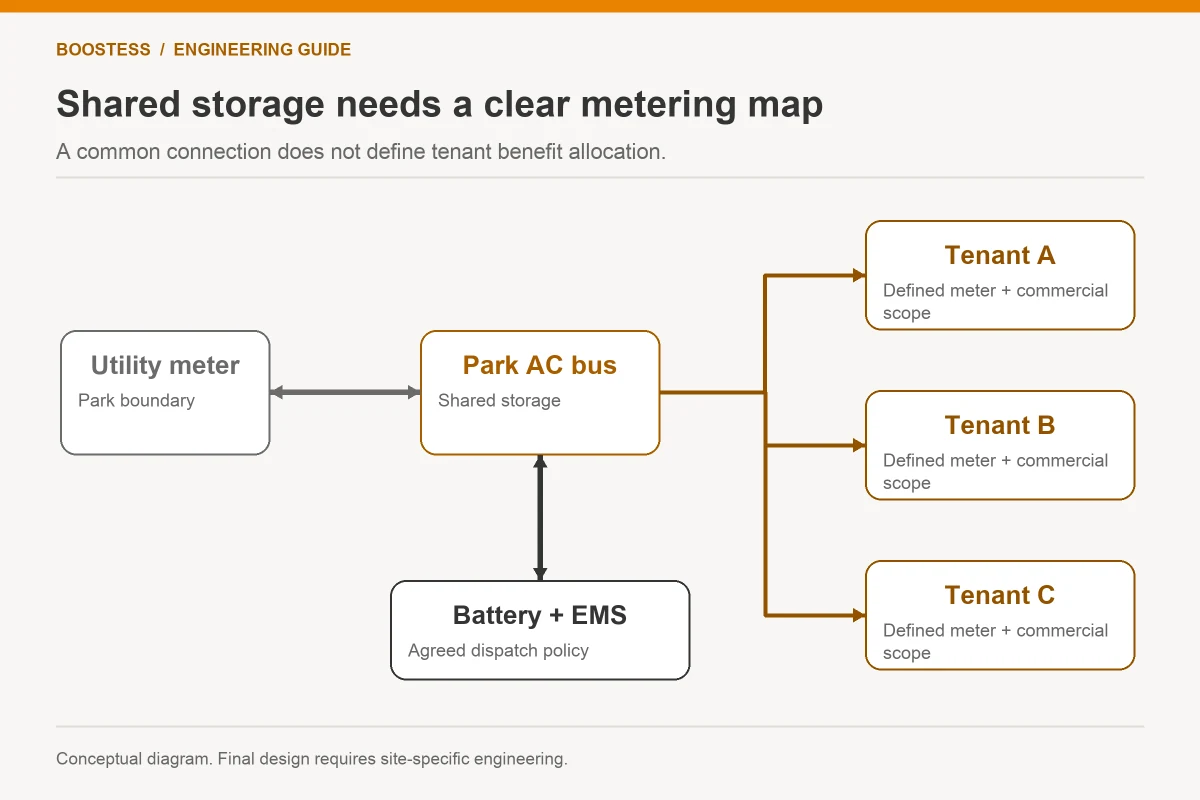
Industrial park shared battery storage needs an agreed metering and commercial boundary before the owner can allocate any benefit to tenants. A battery connected to the park’s main bus changes power at that location. It does not automatically establish how much value belongs to each tenant, who pays for recharge, or which business receives priority during an outage.
Consider two tenants behind one park connection. One creates a short afternoon peak while the other consumes steadily. A shared battery can change the park’s connection profile, but a simple split by floor area may not reflect those operating patterns. The project needs electrical measurements and a transparent allocation method. This article explains the decisions that make a shared-storage proposal auditable.
Key Takeaways
- Draw the utility, tenant and battery meter boundaries on one diagram.
- Separate physical performance from tenant settlement rules.
- Assign dispatch authority and reserve rights before selecting cabinet or container capacity.
On this page
- One battery can affect several different accounts
- Write an allocation rule that survives a disputed month
- A hypothetical shared-peak example
- Select capacity against the common boundary
- Reserve rights can conflict with daily dispatch
- Plan for tenant changes and disputes
- Commission the measurement and control arrangement
- Questions before tenants sign
One battery can affect several different accounts
Begin with the site connection agreement and billing arrangement. Identify who holds the utility contract, which meters determine tenant charges and whether tenant bills reproduce utility terms or use another agreed method. Have the responsible commercial and legal advisers confirm the applicable local permissions. Do not assume the arrangement used by one industrial park is available elsewhere.
Map all relevant meters: utility revenue meter, main site measurement, tenant submeters, PV generation meters and storage charge/discharge measurement. Show their positions and sign conventions. A tenant can continue to consume the same energy while the battery changes the timing of imports at the main connection. These are compatible observations at different boundaries.
Record meter quality and data availability. Missing tenant intervals can prevent fair allocation even when the main connection data are complete. The contract should state the measurement resolution, time alignment, reconciliation method and treatment of corrections. Settlement requires reproducible records, not screenshots from independent vendor dashboards.
The DOE BESS evaluation method uses metered energy time series for deployed-system assessment. Apply that measurement discipline to shared storage by retaining the boundaries needed for both technical verification and commercial reconciliation. The method itself does not prescribe tenant charging rules.
Write an allocation rule that survives a disputed month
Possible allocation methods include an agreed fixed share, a measured contribution to a defined peak, a contracted capacity reservation or another approved commercial structure. Each has different consequences. The owner should show tenants a worked example before asking them to commit to the project.
A fixed share is straightforward but may not track actual use. A peak-contribution method needs reliable time-aligned data and a definition of the relevant event. A reserved-capacity method may be easier to plan around, but it needs rules for unused reservations and overlapping requests. Choose the method that fits the agreement and can be measured consistently.
Separate recharge energy from benefits. If the park buys energy to charge the battery, state how that cost enters settlement. Include losses, auxiliaries and any other agreed operating costs. Otherwise a calculation can distribute avoided imports while leaving the energy needed to create them unassigned.
Avoid calculating tenant benefits by separately optimising each tenant and summing the results. Individual best-case dispatches can compete for the same battery power or energy. Model the common system once, then apply the agreed allocation method to that result. This prevents the proposal from promising more shared capacity than physically exists.
A hypothetical shared-peak example
Assume Tenant A consumes 180 kW and Tenant B consumes 120 kW during one agreed thirty-minute event. Shared services add 40 kW. Total site demand is therefore 340 kW. Suppose storage discharges at 80 kW through that period, reducing the conceptual connection demand to 260 kW.
Delivered battery energy is 40 kWh for the event. This describes physical dispatch only. It does not determine which tenant receives a credit. If the contract allocates the event’s tenant portion according to A’s and B’s simultaneous load, A’s proportion is sixty percent and B’s is forty percent. The treatment of the shared-services share still needs its own agreement.
Now consider a different month when Tenant B’s shift changes and A causes the main site’s highest event alone. A fixed annual allocation and an event-based allocation may produce different settlements. Neither can be called correct without the agreed contractual method. Present both examples while designing the agreement so tenants understand the consequences.
| Boundary | Hypothetical observed quantity | Decision it supports |
|---|---|---|
| Main connection | 340 kW before, 260 kW during dispatch | Shared physical demand effect |
| Battery AC meter | 80 kW for 30 minutes | 40 kWh delivered dispatch energy |
| Tenant meters | A 180 kW, B 120 kW | Agreed allocation inputs |
| Shared-services meter | 40 kW | Owner/common-service treatment |
Every figure in this table is illustrative. The real project must use its applicable tariff and measured profile. Do not translate the example into a bill-saving amount without a verified commercial calculation.
Select capacity against the common boundary
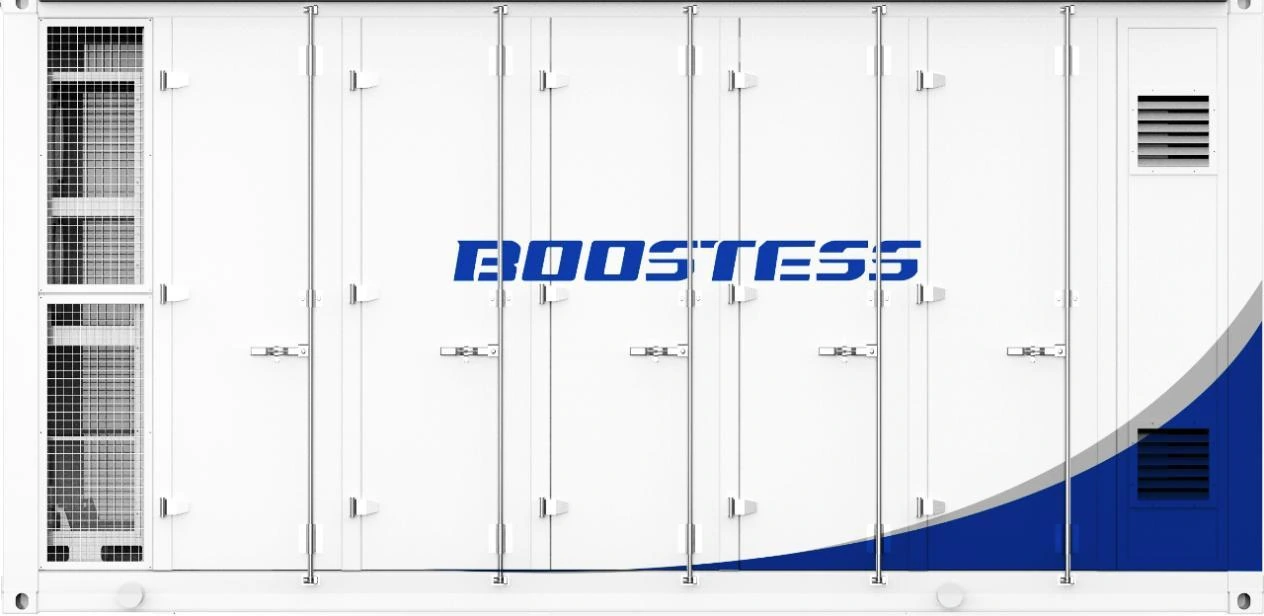
The BOOSTESS brochures document a 125 kW / 261 kWh liquid-cooled cabinet and a 5 MWh liquid-cooled container. These are different equipment scales to compare with the park’s shared duty. The container’s nominal 5,015 kWh energy cannot be compared with a cabinet solely by multiplying tenant floor area.
For the hypothetical 80 kW event, the cabinet’s nominal 125 kW output is above the assumed dispatch power. Confirm actual available AC power and usable energy under the agreed conditions, along with the reserve policy. If several tenants later require 200 kW simultaneously, more nominal energy in the same single cabinet would not fix the power mismatch.
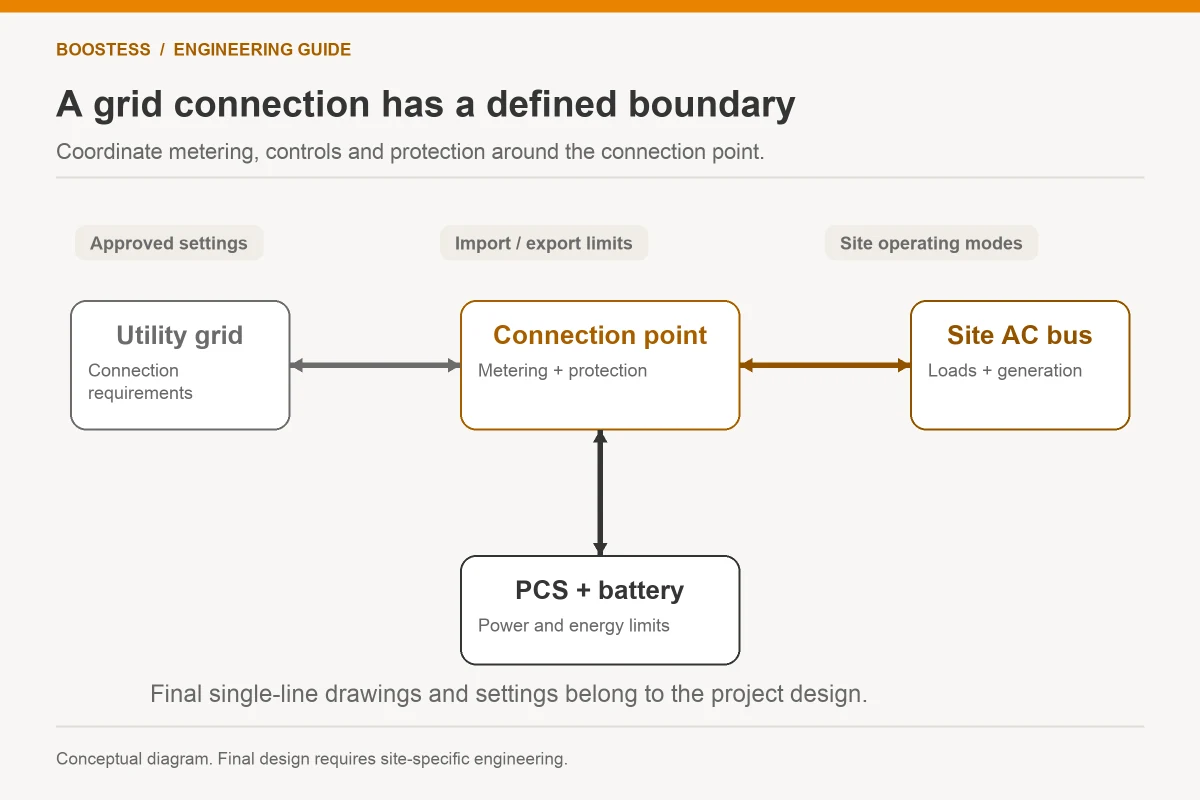
Review the common transformer, bus, protection and connection limits. Increasing storage count can change fault analysis, communications and dispatch coordination. The approved expansion configuration needs its own engineering assessment. Product parallel-operation language does not establish that the park’s existing network can accept every proposed stage.
The commercial versus utility-scale BESS discussion helps distinguish project scale, but the park’s real choice should follow its electrical boundary and duty. An industrial park can have a large shared system without becoming a utility project under every applicable commercial rule.
Reserve rights can conflict with daily dispatch
If tenants expect outage support, define who has a reservation and which circuits are supported. A promise of “backup for the park” is too vague. One tenant may need communications continuity while another wants process restart energy. Their requirements can conflict at both the power and energy boundaries.
Assign control priority. Protective functions remain governed by the approved system, while commercial priorities need an authorised owner. State whether a tenant can request higher reserve, whether that request reduces another tenant’s available service and how temporary changes are recorded. The controller should implement the approved rule, not negotiate between businesses.
Ask how availability is reported. A dashboard SOC percentage does not show each tenant’s remaining allocation unless the system and contract define it. The owner needs a clear statement of available energy, active reservations and restrictions. Avoid presenting a commercial allocation as if it were a separate physical battery bank.
The DOE technical specifications template includes operating and monitoring requirements useful for procurement. Shared storage should add its own reserve, authority and settlement definitions. The editable federal template is a reference, not a local industrial-park regulation.
Plan for tenant changes and disputes
A tenant moving out can leave a capacity reservation and cost allocation unmatched to the remaining loads. Define how the agreement treats departure, replacement tenants and changes in production. The electrical system can remain unchanged while the commercial basis requires revision.
Keep a monthly reconciliation record. It should identify the source data, active rules, tariff version, system availability, exceptions and corrections. Allow the parties to reproduce a settlement from exported records. A dispute should not depend on whether a single supplier still operates the original cloud portal.
Separate technical service responsibilities from commercial administration. The storage maintainer can verify equipment behaviour, but it should not silently determine tenant credits. The park operator should identify who approves allocation changes and who investigates anomalous meter data. Clear responsibility reduces the chance that a technical alarm becomes an unresolved billing argument.
Commission the measurement and control arrangement
Acceptance should verify meter direction, time alignment, energy reconciliation and command authority before testing economic dispatch. Apply a known change in site operating state through an approved test method and check how the main, tenant and battery measurements relate. Document any measurement limitations.
Then test simultaneous tenant requests, reserve conflicts, low available battery energy and loss of an allocation input. Define whether the system continues physical dispatch when commercial data are incomplete. These are distinct functions; it may be possible to operate safely while withholding a settlement until records are corrected.
Handover should contain the one-line diagram, meter register, data dictionary, dispatch sequence and allocation workbook. Preserve the versions used for acceptance. Recheck the boundaries when PV, a tenant feeder or another storage unit is added. Shared storage works as a common asset only when its technical and commercial records remain consistent.
Questions before tenants sign
Does each tenant need a separate battery?
Not necessarily. A shared system may serve the common connection, but benefits and priorities require an agreed method. Compare the electrical and administrative implications of shared and separate arrangements before deciding.
Can individual tenant savings simply be added together?
Only if the calculation respects the shared system’s simultaneous limits and the applicable settlement rules. Independent best-case models may allocate the same capacity more than once.
What should tenants be able to verify?
They should be able to trace their settlement to the agreed meter data, allocation rule and documented exceptions. They also need clear reserve and availability rights where backup is included. That evidence connects the shared equipment to the service each business actually purchases.