
Demand Response and Peak Shaving: Avoid Counting the Same BESS Benefit Twice
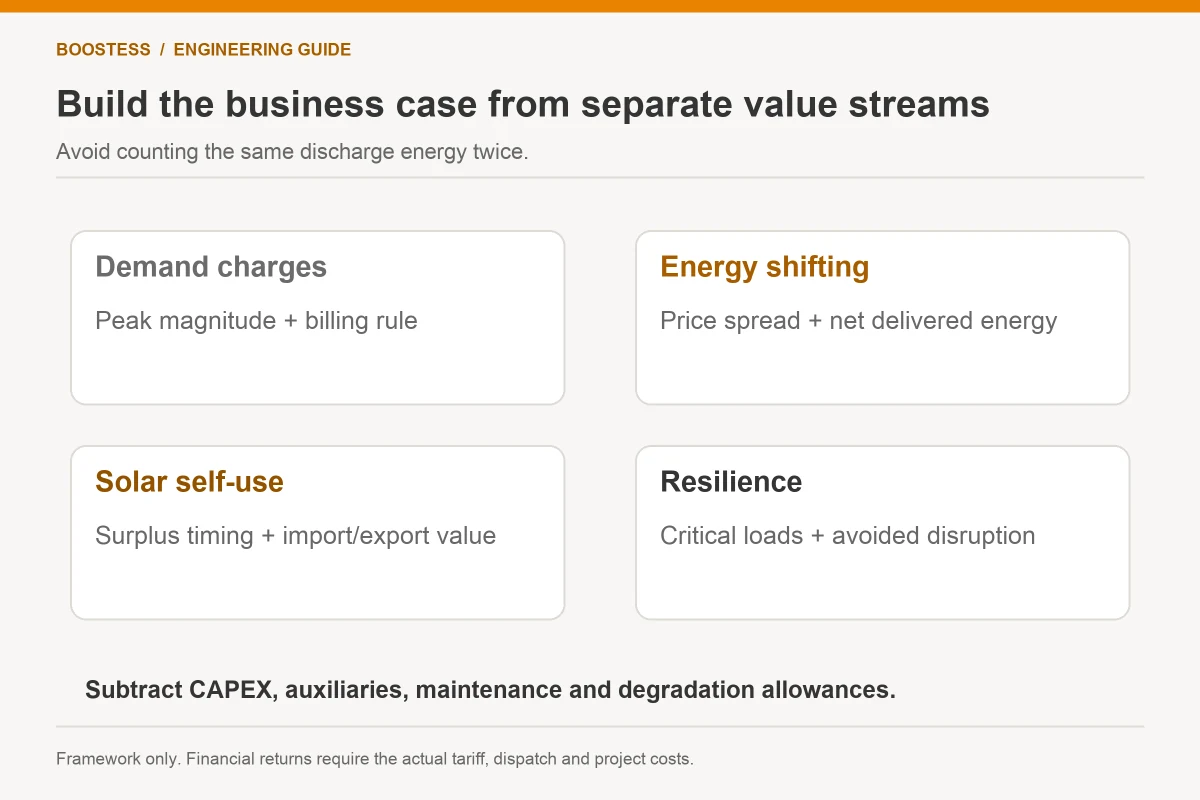
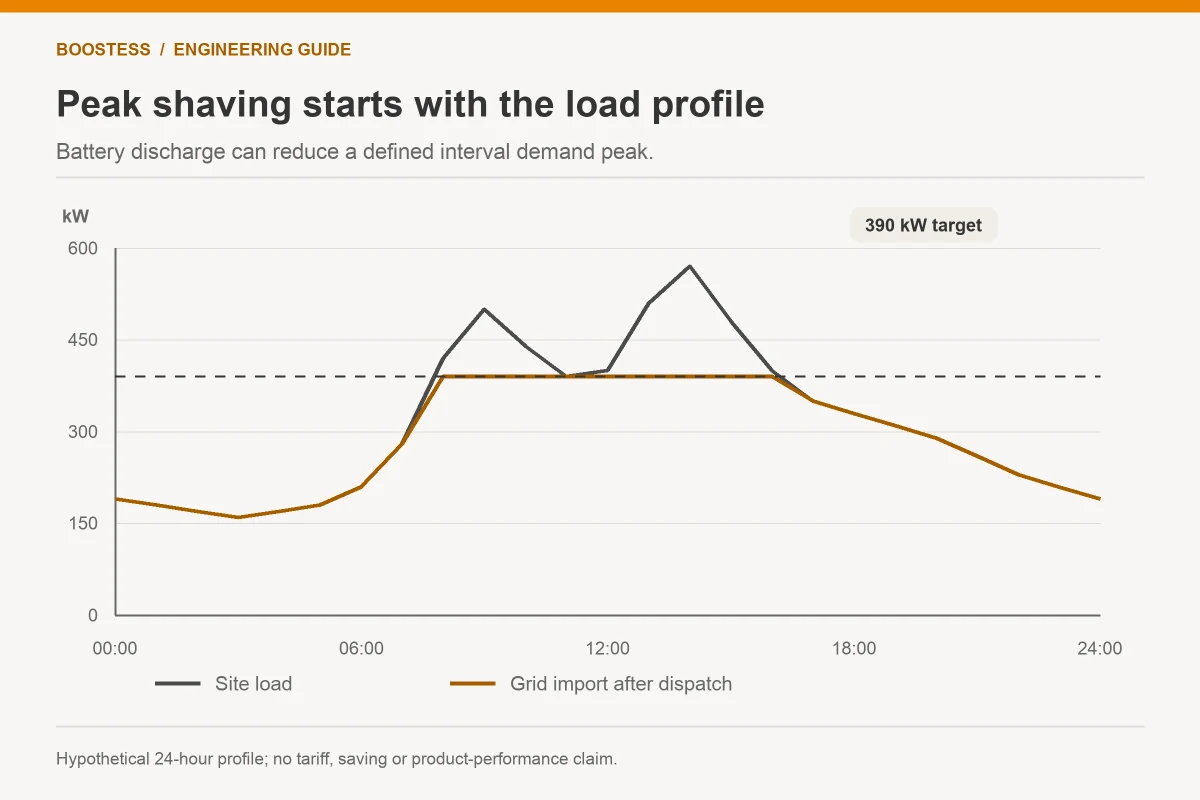
A BESS can support demand response and daily peak shaving when their dispatch and settlement rules are compatible. One discharge may contribute to both; two independent obligations cannot each assume exclusive access to the same battery power and energy. Build one dispatch calendar before adding separate savings estimates. Each benefit needs a defined meter boundary, operating window, energy requirement and rule for resolving a conflict.
The problem is easy to miss in a proposal. A tariff model may assume that the battery is ready for every factory peak, while a demand-response estimate assumes that the same battery remains available for an outside instruction. If both needs occur together, the plant must choose a priority or buy sufficient capability to satisfy both. A project described as a combination of services still has one physical system.
Review the operating characteristics of the 105kW/241kWh cabinet or 125kW/261kWh cabinet against that calendar. Their rated power and nominal energy are separate constraints, not a combined revenue promise.
Key takeaways
- Test competing services in the same time series.
- Separate incremental income from savings the battery already earns.
- Record priority, reserve and measurement rules before committing capacity.
On this page
- Identify the benefit at its measurement point
- Put every obligation into a single calendar
- Distinguish power availability from energy availability
- Check whether one action creates both outcomes
- Build an incremental value table
- Define a control priority that operators can understand
- Include throughput and maintenance in the decision
- Test conflicts before accepting the controls
- Questions about combining services
- Ask for an integrated operating case
Identify the benefit at its measurement point
Start by writing how each proposed benefit is measured. Peak shaving may depend on a site’s billing demand. Demand response may depend on a program’s event performance and its specified baseline. Energy shifting depends on when electricity is purchased or used. Backup readiness concerns available energy when a disturbance occurs.
These objectives can share hardware while using different measurements. A reduction in grid import can affect more than one calculation, but it does not follow that each calculation produces an independent payment. The owner needs the actual tariff and program documents, including eligibility, settlement and nonperformance terms. Avoid importing a rule from a different utility territory.
The DOE BESS evaluation method uses metered charge and discharge records for performance assessment. For service stacking, apply that measurement discipline to the proposed benefit: identify the relevant meter, time interval and calculation. Keep the physical operating record separate from the contractual settlement record so discrepancies can be investigated.
Put every obligation into a single calendar
A service calendar should include charging opportunities as well as discharge events. The battery needs energy before it can meet a later commitment, and charging may raise site demand during an unfavorable interval. A calendar that contains only revenue hours is incomplete.
Record production shifts, expected solar output, tariff periods, event windows, backup reserve and maintenance. Represent uncertain events explicitly. If a program can call the battery with little notice, ask how much energy must remain uncommitted and how often that restriction applies. The reserve affects the energy available for normal operation.
REopt evaluates site energy-system tradeoffs. Its relevance here is the need to consider the site as a coordinated system rather than add isolated estimates. This article does not present a REopt simulation or predicted savings. The project still needs an approved model using its real load data, dispatch constraints and applicable commercial terms.
Distinguish power availability from energy availability
A battery may have enough stored energy for an event but insufficient discharge power to meet simultaneous demands. It may also have enough power initially and run out of usable energy before the window ends. Check both limits throughout the operating sequence.
Consider an explicitly hypothetical site whose control plan requires 80kW of battery support for one hour. Ignoring losses for this simple planning illustration, that calls for 80kWh of delivered energy. If a separate commitment requires an additional 60kW of physical discharge beyond the 80kW site-support requirement during the same hour, the combined demand is 140kW and 140kWh. A power limit below 140kW would prevent full simultaneous delivery, even if stored energy were ample.
Do not apply those illustrative values to a specific product without checking its operating conditions. Actual delivery also involves SOC limits, auxiliary demand, power conversion, temperature and reserve. If the event continues beyond the assumed hour, the energy constraint changes. The control plan needs an answer for the full event, not only its opening moment.
The supplied 125kW/261kWh integrated liquid-cooled system makes the hypothetical concurrency problem tangible. A 140kW combined instruction exceeds its 125kW rated AC power by 15kW, even before reviewing the available energy or environmental conditions. That comparison is a power-boundary check, not a prediction of actual dispatch. A project could revise the commitments, choose an approved multi-unit arrangement or select another configuration. It must also distinguish this integrated system from the separate 261kWh DC cabinet, whose AC capability depends on the chosen external conversion equipment.
Check whether one action creates both outcomes
Some benefits overlap positively. Discharging during a site peak may also meet a response instruction. In that situation, the same action can contribute to two objectives. The financial analysis must establish whether the second value is genuinely incremental under the applicable contract.
Other benefits compete. An early response event can consume energy reserved for a later tariff peak. Holding backup reserve can reduce both activities. A maintenance outage can remove availability for every service at once. These relationships should appear in the model rather than be hidden behind an annual utilization assumption.
The IRENA analysis of firm solar and wind evaluates resource quality and system configuration in electricity delivery. Its broader planning lesson is that storage value depends on the configured task. It does not establish that every additional service adds revenue without changing the rest of the system’s performance.
Build an incremental value table
Separate the original business case from the added service. List gross additional receipts, lost existing value and incremental costs. Keep uncertain payment assumptions visible. The following figures are hypothetical annual planning inputs, not a quoted project return.
| Item | Illustrative annual value |
|---|---|
| Existing peak-shaving value | 12,000 currency units |
| Gross added service receipts | 8,000 currency units |
| Peak-shaving value lost through conflicts | 3,000 currency units |
| Added service and operating costs | 2,000 currency units |
| Incremental value before other project effects | 3,000 currency units |
The additional service contributes 8,000 minus 3,000 minus 2,000, or 3,000 currency units in this example. Adding 8,000 to the original 12,000 would omit the conflict and cost assumptions. The table also excludes financing, taxes, penalties and any capacity change; a full project analysis must address whatever applies.
Test a lower receipt case, a higher event-frequency case and an extended outage case. A service that works under one favorable assumption may weaken under another. The owner should be able to trace each changed result back to the operating calendar or commercial document that caused it.
Define a control priority that operators can understand
Write the priority rule before commissioning. A controller should not be left to resolve conflicting commercial instructions through an undocumented default. The owner, integrator and service provider need to agree which instruction prevails and when an override is allowed.
A priority schedule might identify safety constraints, essential backup reserve, connection limits, contracted dispatch and routine tariff optimization. The exact order is project specific. Record the rule for insufficient SOC, an unavailable PCS, communications loss or a site load exceeding the forecast. Also state who receives an alarm and who may change the schedule.
Use clear decision language. “Optimize revenue” does not explain what happens when preserving backup energy reduces an event response. An operator needs to know which obligation applies, what the system will do and what evidence will be recorded. Keep the approved priority policy with the sequence of operations and the commercial commitments.
Include throughput and maintenance in the decision
More dispatch can change energy throughput, service requirements and retained capacity. A proposed service should be reviewed against the model-specific operating limits and warranty. Do not assume that unused hours mean unused battery life or that a cycle claim permits every dispatch pattern.
Track how the additional service changes charging, SOC range, temperature exposure and energy delivered. If the supplier provides a lifecycle projection, ask for the duty profile used in it. A projection based only on routine daily peak shaving should not be accepted as evidence for a substantially different response schedule.
Maintenance needs the same treatment. Planned work can reduce availability during a service window. Obtain a process for notification, rescheduling and return to service. The annual model should reflect the agreed availability assumptions, while the actual operating record should show whether they were met. Assign responsibility for both rather than leaving them between the owner and aggregator.
Test conflicts before accepting the controls
The acceptance plan should include a tariff peak overlapping a service instruction, an event at minimum allowed reserve and an event during a communications fault. Qualified personnel should design and conduct these tests using the approved system procedures.
Define the evidence in advance: site import, battery power, SOC, instruction time, selected priority and reason for any curtailed response. A dashboard screenshot alone may not establish the operating sequence. Synchronized records help explain whether the controller followed the agreed rule and whether a limit prevented further delivery.
Also test recovery. The system may need to recharge after an event without creating a new site peak or violating its connection limit. A service is not complete when discharge stops. Its recovery behavior can determine the next day’s availability and the monthly electricity bill.

Questions about combining services
Can peak shaving and demand response run together?
They can when the physical operating limits and commercial rules permit it. Model overlap, reserve and recovery in one time series, then verify the agreed priority in commissioning. Simultaneous feasibility should be demonstrated rather than assumed.
Should backup reserve be included in available service capacity?
Only according to the owner’s approved reserve policy. Energy reserved for essential loads is not automatically available for commercial dispatch. Any permitted reserve change needs an explicit decision and a record.
Is gross service revenue enough to compare offers?
No. Compare incremental value after lost existing benefits, added operating costs and applicable project obligations. Keep uncertain receipts and penalties separate so the owner can assess their effect.
Ask for an integrated operating case
Request one model and one control policy covering all proposed services. Keep the settlement rules, meter boundary, energy limits and maintenance assumptions together. This gives the owner a basis for deciding which commitments the BESS can actually support.
Review the system integration scope and send BOOSTESS the site tariff, load record and proposed service obligations through a project inquiry. A coordinated assessment can identify conflicts before equipment and commercial commitments are fixed.