Mining Microgrids: Use BESS to Manage Diesel Reserve and Load Steps
Mining microgrid battery storage should be specified around the mine’s changing power demand and the operating limits of its diesel fleet. The battery may provide short-duration support, absorb available renewable generation or help manage a planned generator transition. Each duty requires defined power, energy and control behaviour; none establishes a universal fuel-saving percentage.
A mine is also several electrical problems sharing one site. Process motors, ventilation, pumping, communications and accommodation can have different consequences when power is interrupted. The design team needs to agree those priorities before reducing generator reserve or adding a container of batteries. This guide explains how to structure that decision and the evidence needed to verify it.
Key Takeaways
- Separate the loss of a generator from a load step and from an extended energy shortage.
- Preserve mine-specific process and safety requirements in the dispatch model.
- Verify fuel effects using generator data and comparable operating records.
On this page
- Start with the mine’s operating events
- Three reserve questions need separate answers
- A hypothetical generator-transition calculation
- Generator limits belong in the controller specification
- Choose equipment after defining the bus and duty
- Measure fuel effects against a comparable baseline
- Acceptance must verify transitions and recovery
- Procurement questions
Start with the mine’s operating events
Build the load study around events that the operations team can identify. Record process starts, pump changes, shift transitions, renewable output changes and generator maintenance. Match them to electrical measurements. The daily maximum alone cannot show how quickly demand rises or how long support is needed.
Keep the consequences of a disturbance visible. Some process equipment may accept an orderly stop; other loads may have an approved continuity requirement. The responsible mine specialists must define these boundaries, including the treatment of safety-related loads. Battery sizing should follow that assessment rather than substitute for it.
Ask the electrical designer to distinguish steady demand, temporary starting demand and the network’s voltage or frequency response. An energy model based on fifteen-minute values may be useful for dispatch economics but insufficient for a fast disturbance. Use the data resolution and engineering study appropriate to each question.
The DOE microgrid development checklist provides a planning framework for combined sources and loads. A mine should attach its process priorities, generator records and operating events to that framework. The checklist does not certify a particular storage configuration’s disturbance performance.
Three reserve questions need separate answers
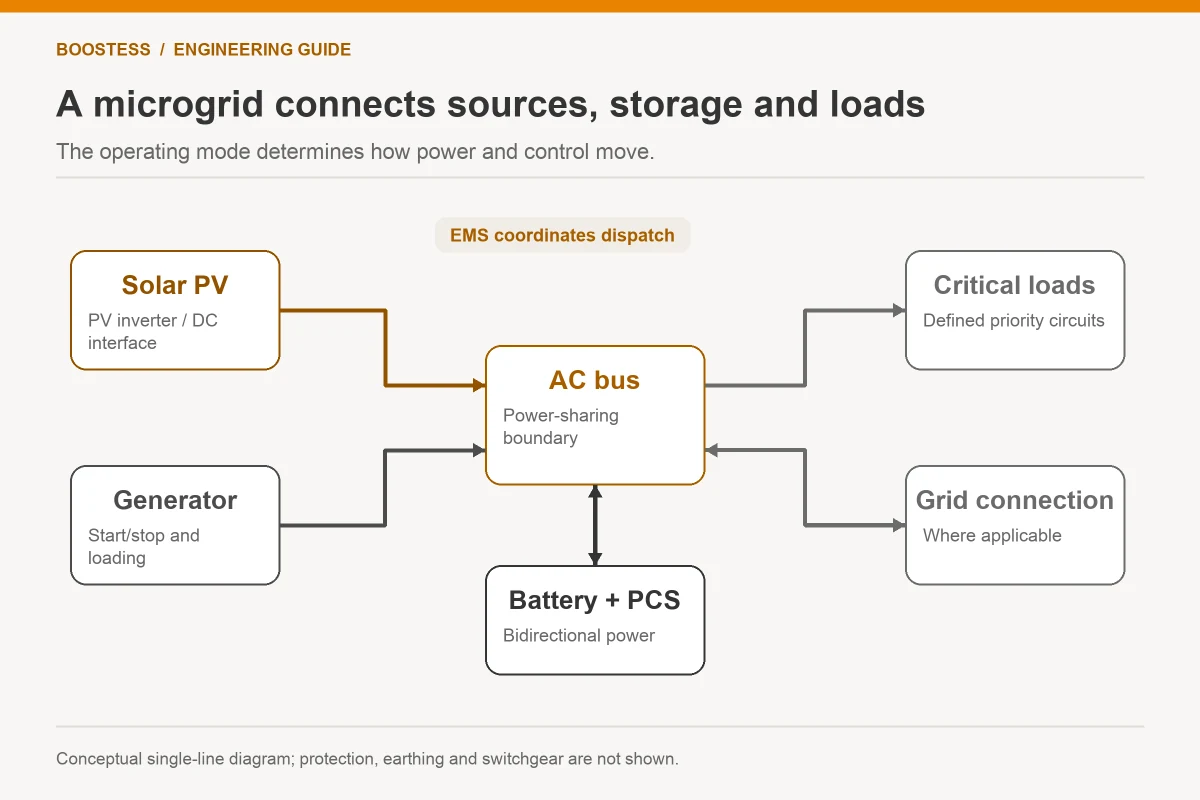
First, consider a sudden load increase while the existing generators remain available. The battery may need to deliver power quickly until the generators respond. The required energy could be modest if the event lasts seconds or minutes, but power and control capability remain demanding.
Second, consider the loss of a running generator. Storage may need to support the bus while another unit starts or selected loads shed. The study must include the actual lost output, detection and response timing, replacement-source availability and remaining battery reserve. A nominal battery energy figure does not resolve bus stability or starting reliability.
Third, consider a prolonged shortage of renewable energy or unavailable diesel equipment. This is an energy-sufficiency question across hours or days. A battery can become depleted, so the operating plan needs a defined endpoint and another approved source or load reduction. Do not present a short bridging duty as evidence of long-duration autonomy.
For each question, state the source that establishes voltage and frequency in the relevant operating state. The DOE explanation of distributed resources and microgrids provides the system context. Grid-forming, black-start and parallel operation must still be demonstrated for the offered equipment and approved mine design.
A hypothetical generator-transition calculation
Suppose a conceptual mine microgrid has a 900 kW site load. Its operating plan anticipates a temporary 300 kW supply gap while another source becomes available. Assume the gap persists for ten minutes. The energy delivered by storage during that period would be 50 kWh, calculated as 300 kW multiplied by one sixth of an hour.
That 50 kWh figure can look small beside a large container’s nominal capacity. It still does not prove the proposed design can supply the transition. The study must establish available discharge power, control response, minimum reserve, bus conditions and restart behaviour. The gap may also become larger if a process load changes during the transition.
Now assume a separate 300 kW gap lasts two hours because the replacement source does not return. The required delivered energy becomes 600 kWh. The event has changed from a short transition to sustained support. Keep the two cases separate in the specification and operator display so that a limited bridging reserve is not mistaken for an extended-energy commitment.
| Hypothetical duty | Power gap | Duration | Delivered energy before allowances |
|---|---|---|---|
| Short transition | 300 kW | 10 minutes | 50 kWh |
| Extended support | 300 kW | 2 hours | 600 kWh |
| Higher transition load | 450 kW | 10 minutes | 75 kWh |
These values illustrate arithmetic only. They are not measured mine performance or recommended reserve settings. The mine’s approved operating requirements should determine the actual cases and margins.
Generator limits belong in the controller specification
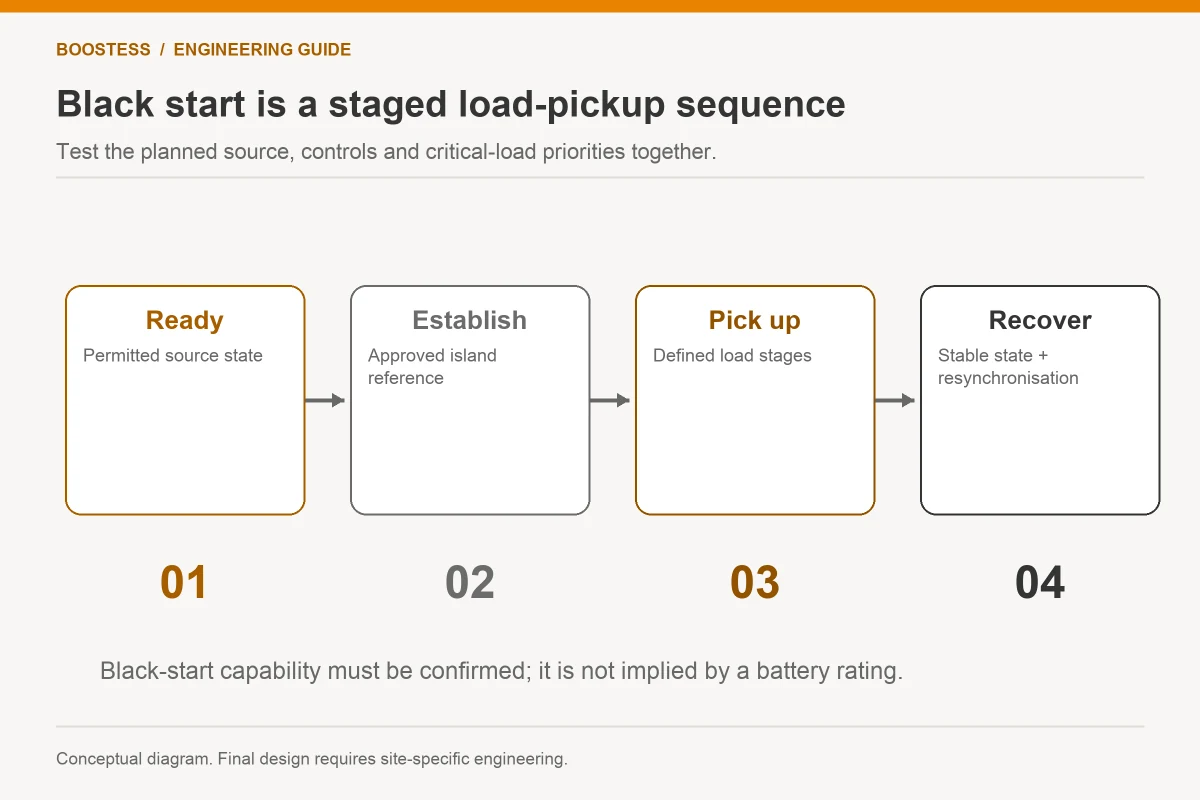
Obtain generator manufacturer limits for loading, ramping, starting, synchronisation and permitted operating states. The controller needs those limits in a documented sequence. A fuel model that assumes any generator can run at any arbitrarily low load is not an adequate basis for changing reserve practice.
Define who owns dispatch authority. The microgrid controller, generator controllers, battery EMS and process systems may each have local priorities. State which commands can override another request and which protections always remain local. Conflicting authority can cause unnecessary starts, unstable cycling or an unexpected loss of available reserve.
Renewable generation adds another headroom question. When load falls and a generator remains online, the site needs a destination for excess power or a permitted curtailment response. Battery charging is available only when its charge power and energy headroom permit it. An already full battery cannot keep absorbing surplus simply because the conceptual diagram shows an arrow into it.
Include communication failures in the operating narrative. Identify which local functions continue, which dispatch actions stop and which operator alarms appear. The system should recover predictably when measurements return, with defined command expiry and state reconciliation. A successful normal-mode demonstration does not establish that behaviour.
Choose equipment after defining the bus and duty
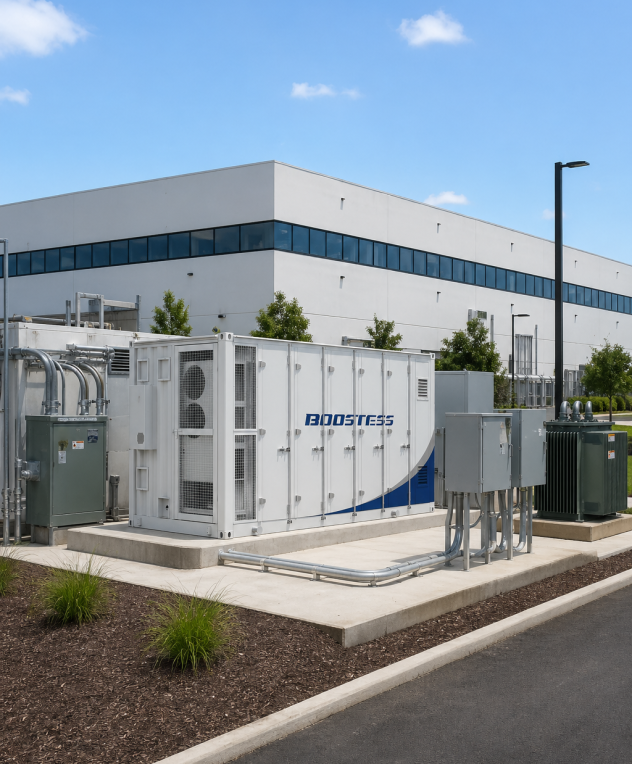
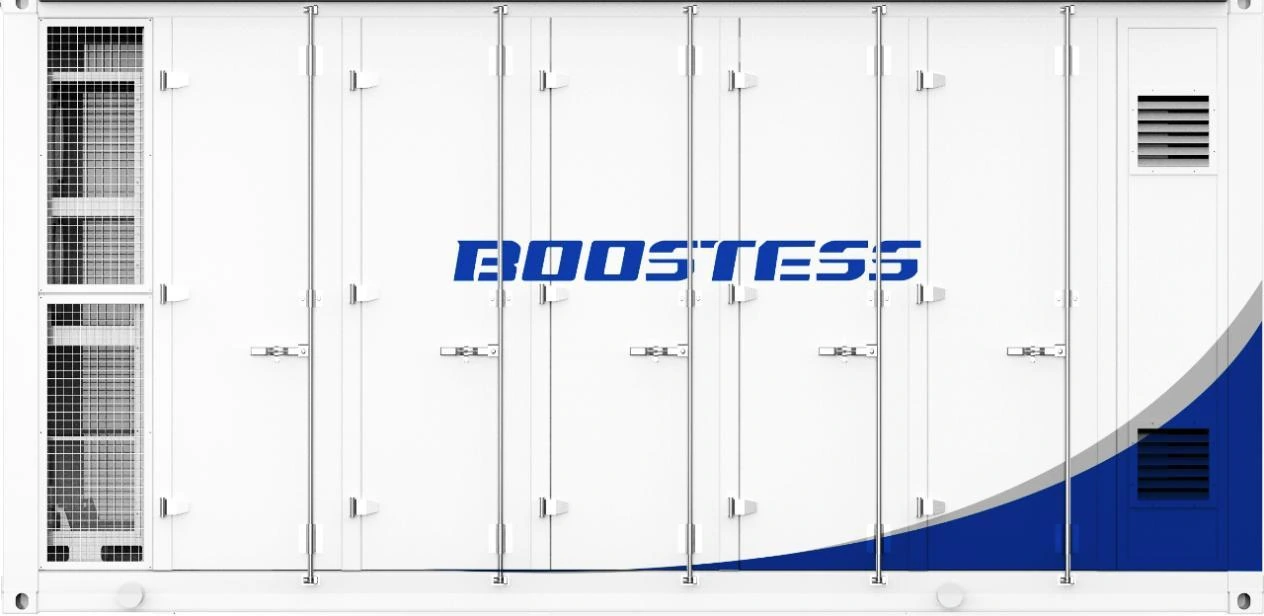
The BOOSTESS brochure specifies a 5 MWh liquid-cooled container with 5,015 kWh nominal battery energy and an associated 2,500 kW rated AC equipment table. This is a documented equipment block to investigate for a larger microgrid. It does not establish that one container meets a mine’s operating or protection requirements.
The procurement team needs the complete approved configuration: conversion equipment, transformer where required, switchgear, network interfaces, auxiliaries and control functions. Confirm the equipment boundary behind each quoted rating. Container battery energy, PCS output and power at the site’s chosen delivery point are different quantities.
Review environmental and service constraints before selection. A mine may have dust, demanding ambient conditions, constrained transport access and long distances from technical support. Obtain the offered variant’s operating limits, derating curve, approved installation drawings and service plan. A general enclosure rating cannot answer every environmental question.
The site’s containerised BESS explanation covers the wider architecture, while system integration services provide a route for assembling the project brief. Keep the brief centred on the mine’s events and acceptance evidence rather than a general container-capacity comparison.
Measure fuel effects against a comparable baseline
A fuel-saving claim requires more than a reduction in generator running hours. Obtain measured fuel consumption or manufacturer fuel curves for the actual units, their load points and relevant conditions. Include start events and the effect of changing which units remain online. Storage recharge losses also enter the energy balance.
Compare operating periods with similar process output and load conditions. A quieter production month may consume less diesel without any contribution from storage. Keep mine output, ambient conditions, renewable production and outages in the evaluation record so that the source of a change can be understood.
The IEA ASEAN electricity and renewables security review offers regional energy-system context. It does not establish a mine-specific diesel reduction or a project payback. Any commercial claim should come from the project’s own measured baseline, tested equipment behaviour and agreed operating model.
Run sensitivities around fuel availability, renewable output, generator maintenance and battery degradation. Show the operator which assumptions force a dispatch change. A model with a precise fuel percentage but hidden operating constraints is less useful than a transparent range tied to defined conditions.
Acceptance must verify transitions and recovery
Agree test scenarios with the mine’s responsible designers and operators. Include the specified load steps, permitted source transitions, low battery reserve and lost measurements using approved test methods. Simulation may be necessary where a live test would put operations at risk. State which evidence comes from simulation and which comes from a witnessed site test.
Record bus measurements, generator status, battery commands, available reserve, alarms and load-shedding actions on a common time base. Define pass criteria for power quality, process continuity and energy duration separately. The final report should show the configuration and software revisions that produced the result.
Handover needs an operator decision table. It should identify actions when reserve falls, a generator is unavailable or renewable production differs from expectation. Add a change process for new process loads and equipment replacements. The reserve plan remains useful only while it matches the mine’s actual configuration.
Procurement questions
Can batteries reduce the number of online generators?
Possibly, when the approved reserve and stability study supports that operating state. Obtain generator limits and test the relevant events. Do not assume nominal battery power creates an equivalent replacement for every generator function.
Does a large container guarantee black start?
No. Black start depends on the complete equipment, controls, supported loads and approved sequence. Ask for model-specific evidence and project verification rather than relying on stored energy.
What should the fuel model disclose?
Disclose load profiles, generator curves, dispatch rules, battery losses, reserve restrictions and comparison periods. Keep projected results separate from verified site measurements, and give operators a way to recognise conditions outside the model’s operating envelope.