
Hotel Battery Backup: Decide Which Loads Stay On
Hotel battery backup starts with a decision about which services remain available during an outage. Keeping a reception computer, refrigeration circuit and selected pumps operating is a different project from supporting every guest room, kitchen and HVAC system. Until those priorities are explicit, a proposed backup duration has little meaning.
The property owner should define the desired operating state with its facilities team and responsible electrical designers. Required emergency services need their own compliant design assessment. This article focuses on scoping ordinary hotel continuity loads and the interfaces between battery storage, UPS equipment and other sources. Its example is a planning exercise, not an operating recommendation for a specific building.
Key Takeaways
- Assign each load a service priority, restart requirement and acceptable interruption.
- Calculate energy from the supported operating state, then verify available AC power and transfer performance.
- Test the low-reserve and restart cases before describing the system as hotel backup.
On this page
Define the hotel operating state
Begin with the guest and staff experience the owner wants to preserve. Will the property remain open to new arrivals? Will it offer limited food service? Can housekeeping continue? Are all occupied rooms expected to retain cooling? Different answers produce different load lists and operating costs.
Create a service inventory with electrical circuits attached. “Maintain reception” might involve networking, booking systems, access control, lighting and charging devices. “Maintain water” might require several pump stages and controls. A service description needs that electrical detail before it enters a battery model.
Distinguish essential continuity from convenience. Selected refrigeration and communications may receive priority while laundry and nonessential kitchen equipment wait. The owner can choose a different hierarchy, but the hierarchy should be documented and authorised. Staff should not discover it during the first outage.
NREL’s building resilience guidance discusses prioritisation of critical loads. A hotel can use that concept to define operating tiers. It does not establish the hotel’s statutory emergency-load requirements or make a battery a substitute for every existing backup arrangement. Obtain the building-specific assessment from the responsible professionals.
The comparison of BESS, UPS and generators gives useful background on distinct equipment roles. The hotel’s design needs to carry those distinctions into a circuit schedule and a sequence of operations.
A load hierarchy should include time
Priority is not just an on-or-off label. Some loads need immediate continuity; others can restart after the electrical source becomes stable. A network device may need local UPS support, while a pump may accept a controlled delay. Record the acceptable interruption for each service rather than assigning one transfer requirement to the entire hotel.
Also record how long each load must operate. A water pump may run intermittently, while networking stays on continuously. An elevator’s energy requirement cannot be inferred from its motor rating multiplied by every outage hour. Its approved operation, starting demand and any restrictions need a separate review.
Use an operating tier table as the first owner approval document:
| Service tier | Illustrative services | Information needed before design |
|---|---|---|
| Continuous operations | Selected IT and communications | UPS interfaces, interruption tolerance, steady demand |
| Controlled restart | Selected refrigeration and pumps | Restart sequence, starting current, allowable delay |
| Limited guest service | Selected room circuits or a designated common area | Occupancy assumption, duty pattern, load shedding |
| Deferred operations | Laundry or other owner-selected nonessential activity | Manual restrictions, signage and staff responsibility |
These are illustrative categories. The table does not assign a hotel load to a safety classification or authorise a service interruption. Its purpose is to expose the decisions that equipment bids otherwise hide.
Calculate duration from a defined load profile
Suppose a hypothetical hotel continuity plan has 12 kW of continuous communications, controls and selected lighting. Refrigeration averages 18 kW during the chosen outage condition. Selected pumps add an assumed average of 10 kW. The steady equivalent is 40 kW, before any additional service or starting events.
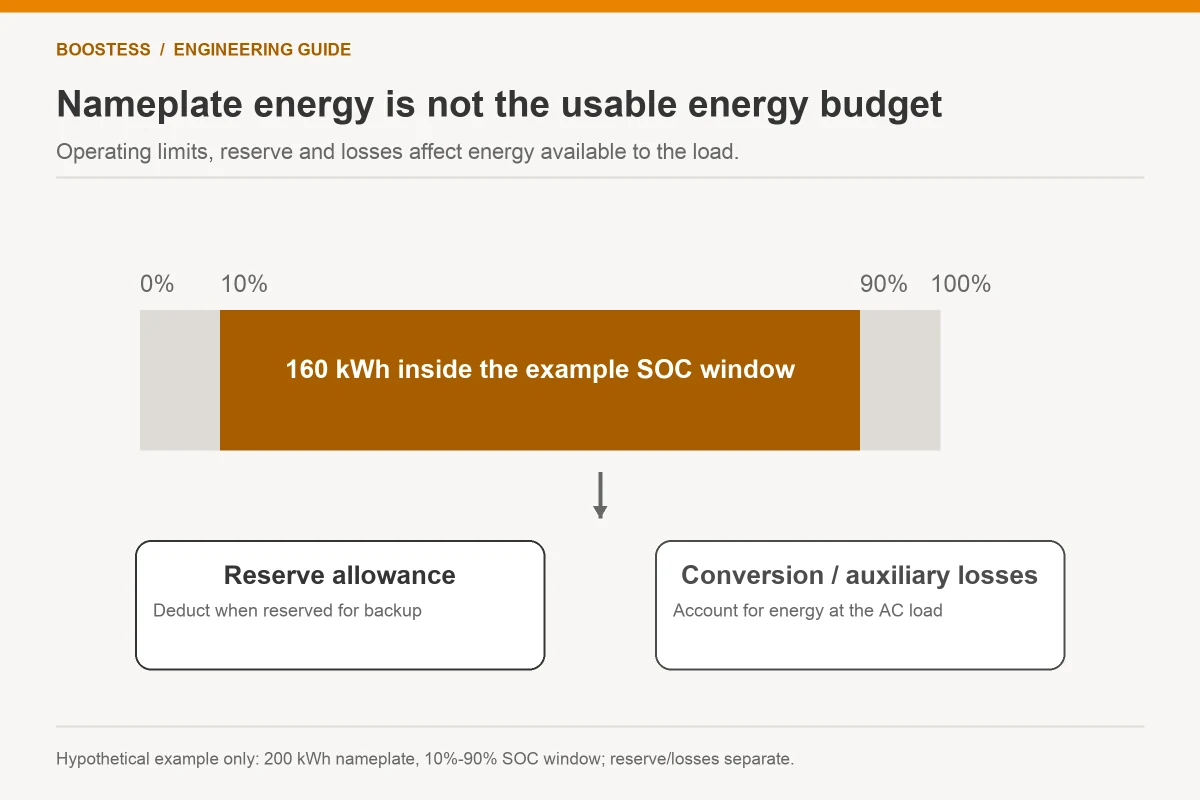
For three hours, that load needs 120 kWh at the supported AC bus. If the owner adds a further 20 kW of selected guest services for those same three hours, the requirement rises to 180 kWh. Adding a service changes the energy requirement immediately; it is not a minor setting in the final software.
Keep the duty assumptions visible. The refrigeration average may change with ambient conditions and kitchen operations. Pumps might run more often when the hotel is full. Evaluate a demanding credible operating day, not only a lightly occupied demonstration. Record which assumptions the owner accepts and which need measurement.
The BOOSTESS brochures document a 50 kW / 100 kWh hybrid cabinet and a 105 kW / 241 kWh air-cooled cabinet. Their rated configurations help frame equipment options. The first cabinet’s 100 kWh nominal energy is below the example’s 120 kWh AC requirement. The second has more nominal energy, but its deliverable capacity, reserve and operating mode still need verification before anyone promises three hours.
Transfer, starting and autonomy are separate tests
Stored energy does not prove a smooth transfer to battery supply. Identify the equipment that establishes the supported bus, the switching arrangement and the behaviour of sensitive loads during transition. Some devices may need UPS bridging even where the storage system offers a rapid transfer mode.
Do not interpret a brochure switching time as a whole-building continuity guarantee. Transfer performance depends on the configured system and connected loads. Ask for the measurement boundary, test conditions and supported mode. Have the designer assess whether each critical device can tolerate the resulting disturbance.
Starting demand is another boundary. A hotel can have a moderate average backup load but a large temporary requirement when pumps or refrigeration restart. Review load manufacturer data and use an approved restart sequence. Confirm the inverter’s behaviour when a load fails to start or draws more current than expected.
Restoration to normal supply needs attention as well. The sequence should address source synchronisation where relevant, switching permissions, load recovery and battery recharge. Avoid several controllers independently deciding that all deferred loads should return at once. The owner should receive a single understandable operating narrative even if several vendors supply the hardware.
Decide how daily dispatch affects outage reserve
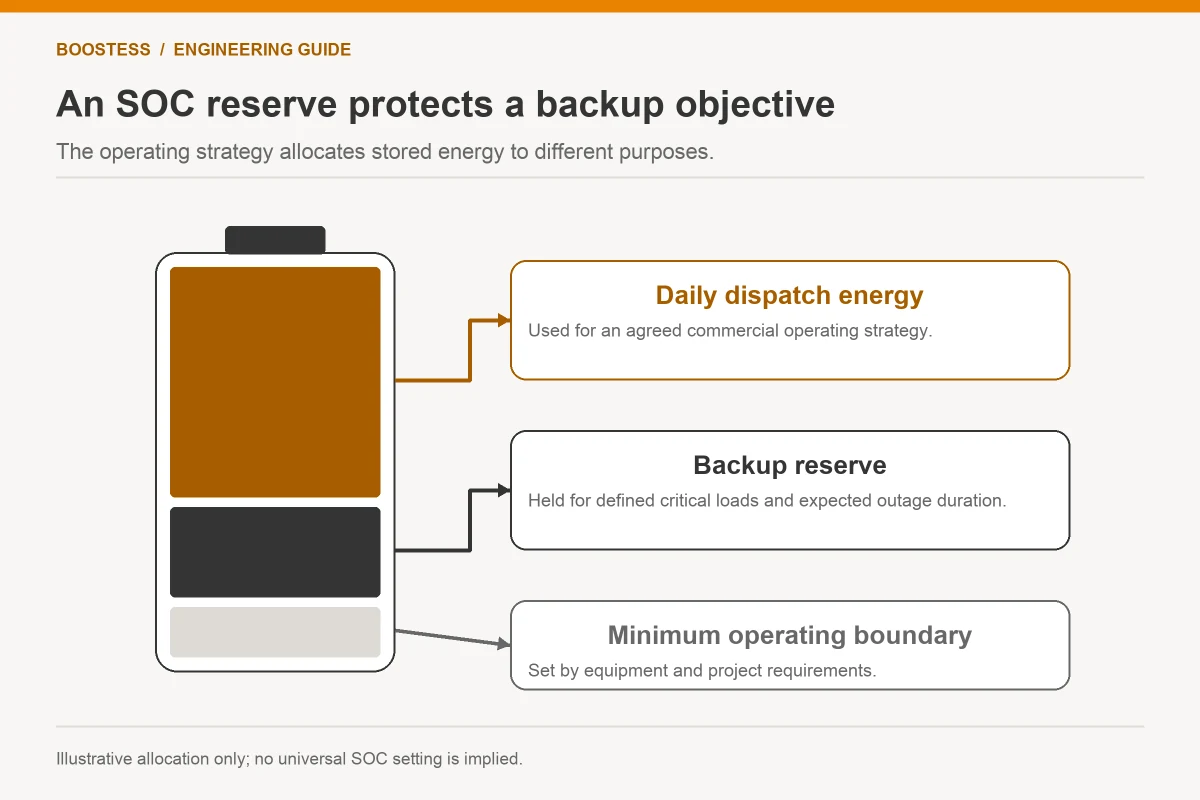
A battery used for ordinary bill management may not be full when the grid fails. Specify a backup reserve policy and show its effect on the energy available for everyday dispatch. If the owner wants a defined outage duration at any time, the starting-state requirement belongs in the control logic and commercial agreement.
Reserve can change with the operating context. Occupancy, planned events, weather forecasts and known grid work may justify a higher reserve. Describe who can change it, how long the change remains valid and how the system reports that it has reached the new target. Avoid a setting that staff assume is active while the battery is still charging toward it.
The IEA battery storage chapter in Global Energy Review 2026 describes battery storage’s role in electricity systems. That broad role does not remove the tradeoff at a hotel: energy held for an outage is unavailable for another simultaneous duty. A project model should account for that conflict explicitly.
Review the broader commercial backup discussion when comparing sources, then apply the hotel’s own load and reserve plan. A generator, solar array and battery may have different availability constraints. Combining them only helps if the controls and source interfaces are part of the approved design.
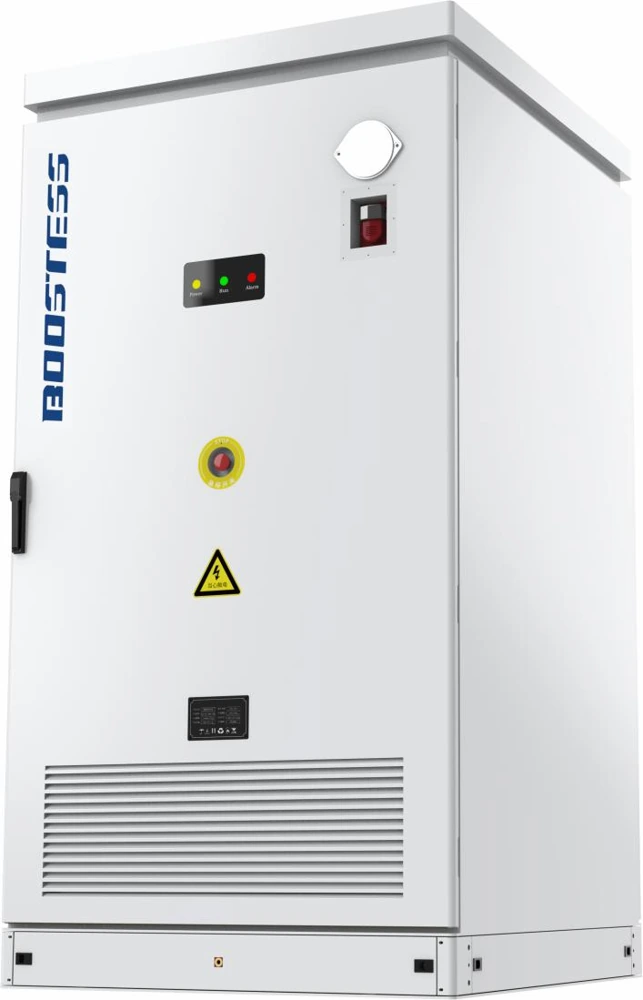
Include occupancy in the accepted load assumptions. A demonstration in an almost empty hotel may not represent refrigeration, water and guest-service demand during a full weekend. For the 105 kW rated cabinet option, compare the expected simultaneous demand with its available output under the agreed conditions, then test the relevant restart sequence separately. If selected guest services expand, update both the AC energy worksheet and the power assessment. Keeping the circuit schedule beside the equipment documents gives the owner a practical way to detect when a service promise has outgrown the originally assessed system.
Give staff an operating plan they can use
Handover should explain what remains powered, which services are deferred, which alarms require action and who can authorise a change. Facilities staff need a clear distinction between economic dispatch limits and protective limits. They should also know how to report an unexpected load addition to the technical team.
Revisit the plan when the property changes. A new kitchen, extra guest rooms or different refrigeration equipment can invalidate the original load assumptions. Add a review step to the hotel’s change process so that electrical continuity claims follow the current building rather than an old equipment schedule.
Acceptance should include representative supported loads, the approved restart order, minimum planned reserve and a lost monitoring connection. Record time-stamped bus power, battery energy, state of charge, alarms and service observations. Define pass criteria for interruption tolerance and operating duration separately.
An outage drill should test communication between staff too. Reception may need to tell guests which services remain available, while facilities staff monitor the technical system. A technically correct load-shedding action can still cause confusion if the property’s service promise is inconsistent with the approved design.
Questions to resolve before a quotation
Can a hotel run all services from one cabinet?
Only a site study can establish that. Compare simultaneous power, usable energy, starting behaviour and transfer requirements with the actual cabinet configuration. A hotel-wide label is not a load calculation.
Is a battery equivalent to a UPS?
The equipment may serve different continuity functions. Verify interruption tolerance for the supported devices and whether separate UPS bridging remains necessary. Battery duration does not establish power quality during transfer.
What should the owner approve first?
Approve the service hierarchy and its operating assumptions. Then obtain an electrical design, reserve policy and acceptance method tied to that hierarchy. This creates a defensible route from guest-service expectations to the selected equipment and documented backup commitment.