Battery Storage for EV Depots with Limited Grid Capacity
Battery storage for EV depots can cover a temporary gap between charger demand and the site’s grid import limit. It cannot remove an energy shortage that persists through every charging window. The useful question is therefore whether vehicles can receive their required energy before departure while the battery has time and capacity to recharge.
That question brings fleet operations into an electrical design decision. Arrival times, vehicle readiness, building loads and charger controls matter as much as the number of charging sockets. A depot with twelve chargers may need less battery power than a smaller site where every vehicle returns together. This guide uses an explicitly hypothetical depot to show how an EPC and fleet owner can define the operating envelope before requesting equipment quotations.
Key Takeaways
- Separate the site’s instantaneous import limit from the energy available over the charging window.
- Size battery support after testing a departure-based charging schedule.
- Specify what happens when reserve energy, charging headroom or communications become unavailable.
On this page
- Begin with vehicles and departures
- Calculate the available energy window
- Check power separately from battery capacity
- Make the charging controller responsible for the empty-battery case
- Recharge is part of the fleet schedule
- Acceptance should include an uncomfortable operating day
- Questions buyers should settle
Begin with vehicles and departures
A charger nameplate describes its maximum output, not a vehicle’s energy requirement. Build the first worksheet around each duty group: expected return time, next departure, arrival state of charge, target state of charge, and energy needed at the charger. Distinguish measured charging energy from energy reported by the vehicle because losses and auxiliary operation can create a difference.
Use ranges where operations are uncertain. One duty group might normally return at 18:00 but arrive an hour later on busy days. A dispatch plan built only around the normal return time can pass a spreadsheet calculation and still leave vehicles unready. Record the latest credible arrival and the earliest required departure, then identify vehicles that can accept delayed charging.
The IEA’s Global EV Outlook 2026 provides current context for electric transport and charging. A local depot decision still needs fleet records; national vehicle growth does not establish the site’s charger simultaneity or connection requirement. Collect those operating inputs before turning a wider market trend into a purchase.
Include depot loads outside charging. Workshops, lighting, HVAC and offices share the connection. A charger controller that sees only charger power cannot reliably enforce a whole-site import limit when a compressor starts elsewhere. Review the roles of the BMS, EMS and PCS when assigning responsibility for measurement and dispatch.
Calculate the available energy window
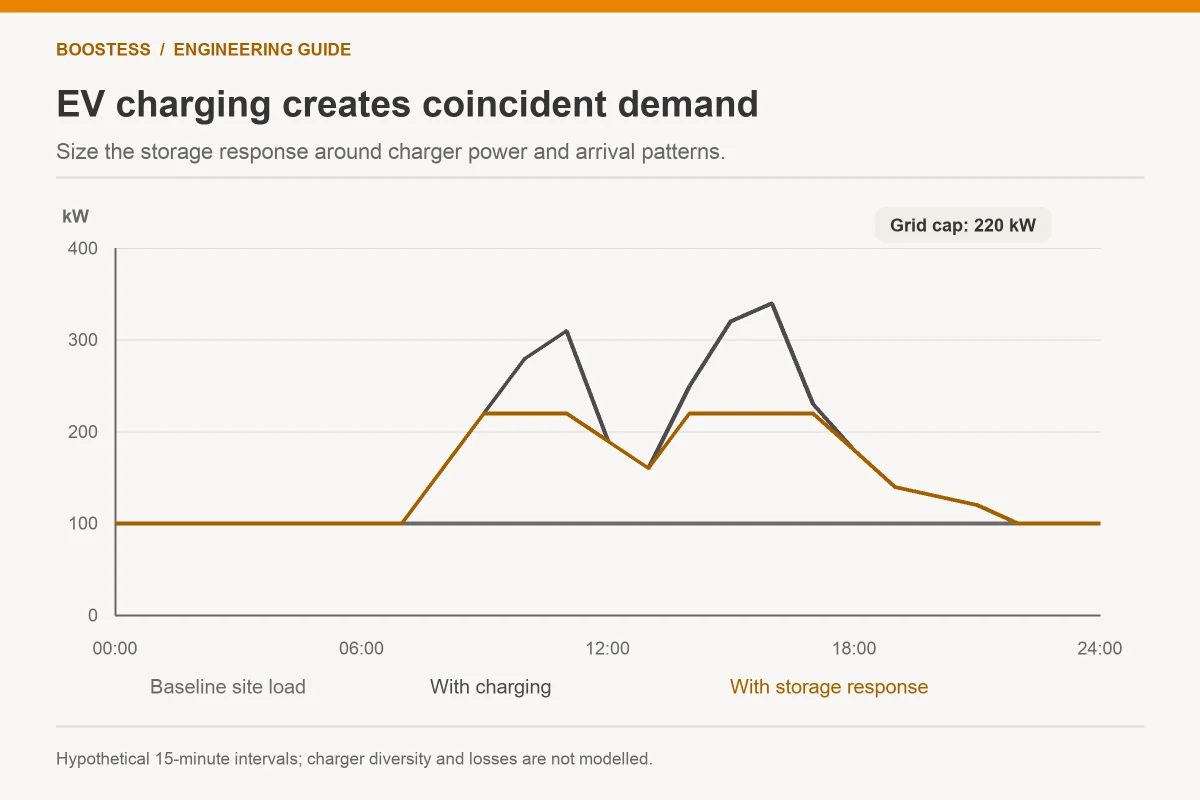
Suppose a depot has a 180 kW import allowance. Building demand during a two-hour charging period is assumed to remain at 60 kW, leaving 120 kW for chargers. Six vehicles each require 60 kWh at the charger before departure. Their total requirement is 360 kWh.
The grid can supply 240 kWh to charging during those two hours, calculated as 120 kW multiplied by two hours. The assumed shortfall is 120 kWh. A battery could address that shortfall if its deliverable energy, discharge power and starting state are suitable. These are illustrative inputs, not measurements from an operating depot.
Now extend the same charging window to three hours. The grid’s available charging energy becomes 360 kWh under the same constant-load assumptions. The energy shortfall disappears, although a controller must still limit simultaneous charger output. Scheduling could solve this version of the problem without additional storage energy. That comparison should appear in the owner’s decision paper.
Time resolution matters. The building may average 60 kW but briefly consume 110 kW. During that period only 70 kW remains under the assumed import ceiling. Use interval data to simulate the full schedule and shorter measurements where needed to assess control response. Do not replace a varying load with its annual average.
| Illustrative schedule | Energy available to charging | Vehicle requirement | Energy shortfall |
|---|---|---|---|
| Two hours at 120 kW grid headroom | 240 kWh | 360 kWh | 120 kWh |
| Three hours at the same headroom | 360 kWh | 360 kWh | None under the stated assumptions |
These rows compare energy across a charging window. The simultaneous charger condition below is a separate power test; it is not an assumption that all six chargers run at 40 kW for the full two hours.
Check power separately from battery capacity
For the two-hour example, suppose the six chargers operate at 40 kW each. Combined charging power is 240 kW. With a 60 kW building load, the site would require 300 kW without storage or throttling. Maintaining a 180 kW import ceiling therefore calls for 120 kW of battery discharge while this condition persists.
The example fits within a nominal 125 kW discharge rating, but that leaves little margin for changes in building load, thermal derating or unavailable equipment. Nominal rating alone is an insufficient procurement basis. Ask for available AC power over the specified temperature range, actual operating mode, permitted duration and agreed reserve state.
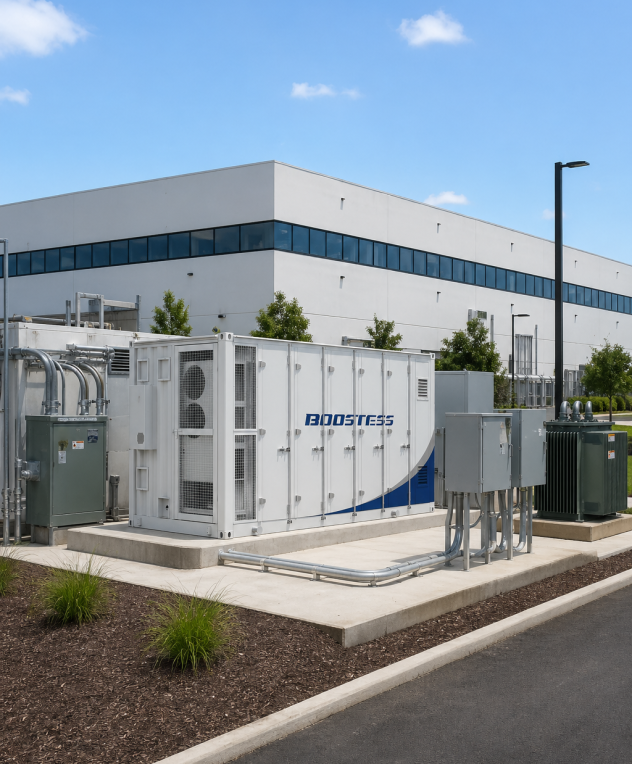
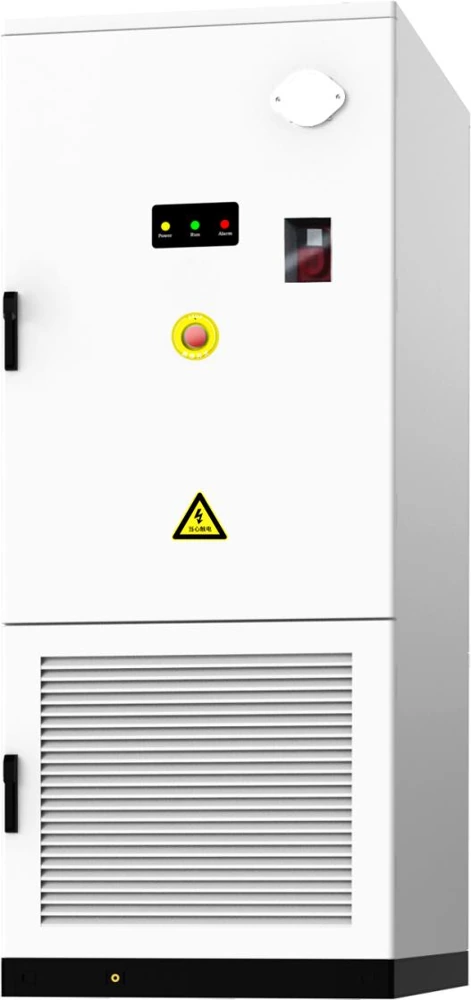
The BOOSTESS manufacturer brochure specifies a 125 kW / 261 kWh liquid-cooled cabinet with LFP cells. That configuration is a useful starting point for comparison. Its 261 kWh nominal energy does not establish the energy available to the depot after reserve, conversion losses, auxiliary consumption and aging. Confirm these boundaries in the quotation and acceptance method.
Test a high-load day as well. If the building rises to 90 kW while chargers still request 240 kW, the gap becomes 150 kW. A single 125 kW rated cabinet cannot cover that assumed gap at its nameplate rating. The controller needs to reduce charging demand, change the schedule or use another approved configuration. Adding kWh alone does not fix an insufficient kW rating.
Make the charging controller responsible for the empty-battery case
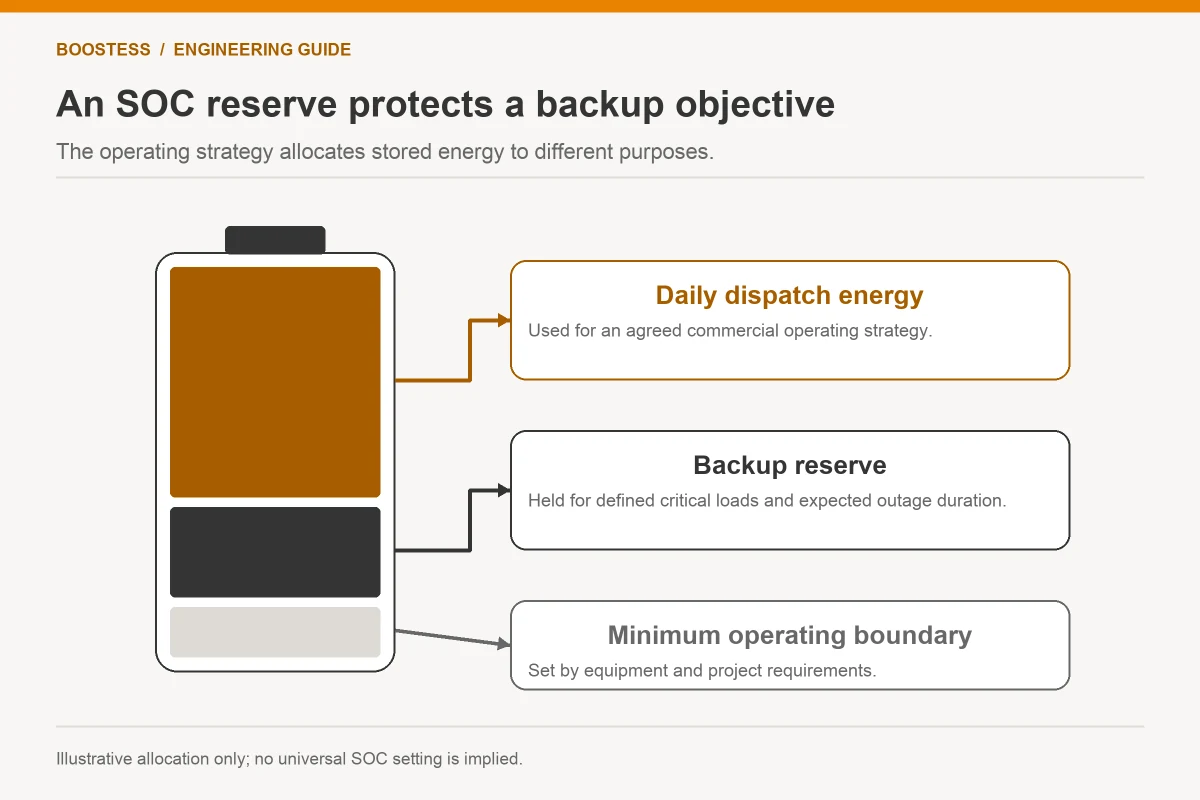
A credible depot control plan has a defined operating state for low battery energy. When the battery reaches its dispatch floor, charger demand must adjust to the remaining grid allowance. Otherwise an import limit that worked during a demonstration may fail on the next long charging session.
Agree the order of control actions. A departure-based controller can prioritize vehicles with the least remaining time and reduce power to vehicles with later deadlines. A fixed priority list may suit a small fleet, but operations staff must be able to revise it when assignments change. Charging fairness and vehicle readiness are different objectives; document which wins during a shortage.
Reserve policy also needs an owner. If storage supports workshop backup, some energy may be unavailable for charging. The EMS should expose that reserved amount to the fleet controller. A hidden reserve is an easy way for two separate vendor models to count the same energy twice.
The NLR REopt platform provides a framework for evaluating distributed energy resources against a site’s economic and resilience objectives. For a depot, the practical extension is to include charging deadlines and operational constraints in the project model, then compare battery dispatch with managed charging. A model result is conditional on those inputs.
Ask what happens if the site meter, charger network or dispatch link stops updating. The contract should name the conservative charging limit, command timeout and local operator response. The fallback must remain compatible with the actual connection agreement; there is no universal setting that works for every depot.
Recharge is part of the fleet schedule
A battery that discharges successfully one evening still needs a feasible path to its next starting state. Plot recharge alongside vehicle charging and building demand. If the connection remains fully occupied overnight and during the following day, the battery’s energy deficit accumulates.
Use the two-hour example again. Replacing 120 kWh of delivered battery support requires more than 120 kWh of charging energy once the agreed loss boundary is included. Do not assume a brochure’s peak converter efficiency equals the full recharge requirement. Request a site-level energy balance that includes standby and cooling loads where relevant.
Solar can help, but only when its generation coincides with available battery charge headroom. A sunny-day forecast cannot serve as the only basis for next-morning fleet readiness. Compare cloudy weather, late vehicle returns and a battery unavailable for maintenance. The solar and battery integration guide gives broader context for the electrical interfaces; the depot model must add the fleet’s own deadlines.
Evaluate staged expansion against the same constraints. More vehicles may require new chargers, more storage, revised schedules or a grid upgrade. The IEA’s grid modernisation report explains the broader need for planning and flexibility. It does not establish that a particular battery eliminates the depot’s need for connection work.
Acceptance should include an uncomfortable operating day
Write the acceptance scenarios before issuing the purchase order. A full-battery demonstration with a light building load proves little about a constrained depot. Test the agreed import ceiling with a building load change, a late-arriving priority vehicle, low available battery energy, a lost communications link and recovery after the link returns.
The record should include time-stamped connection power, battery power, charger commands, delivered vehicle energy, state of charge and alarms. Define the permitted overshoot duration and magnitude using the actual utility requirement. Check that meter sign conventions remain correct when the battery changes from discharge to charge.
The fleet owner should also sign off on the operational result. Electrical compliance and departure readiness need separate pass criteria. If a vehicle misses its energy target, the test report should explain whether the limiting factor was grid energy, charger allocation, battery availability or a wrong arrival assumption. That explanation guides the next design decision.
Questions buyers should settle
Can a battery replace a grid connection upgrade?
It may defer or reduce an upgrade when a limited-duration power gap can be covered and recharge is feasible. A persistent daily energy shortage requires a different solution or a revised operating plan. Obtain utility agreement for the proposed control arrangement.
Should every charger run at maximum power?
Only when doing so meets the fleet objective within the site limits. Lower power over a longer window may satisfy the same departures with less battery use. Assess vehicle acceptance limits and schedule flexibility before choosing a maximum-power strategy.
Which battery figure belongs in the fleet model?
Use guaranteed deliverable energy and available AC power for the agreed conditions, with a separate reserve assumption. Retain nominal kWh as an equipment descriptor. The procurement worksheet should show both, so operations staff can see the margin behind the charging commitment.