Battery Augmentation: Model Future Capacity Before the First Installation
Battery augmentation should be planned before the first BESS installation when future usable energy is part of the project’s promise. Define what energy must remain available, where it will be measured, and how replacement or additional equipment could restore it. Buying enough nominal capacity for the opening year does not establish the energy available throughout the contract.
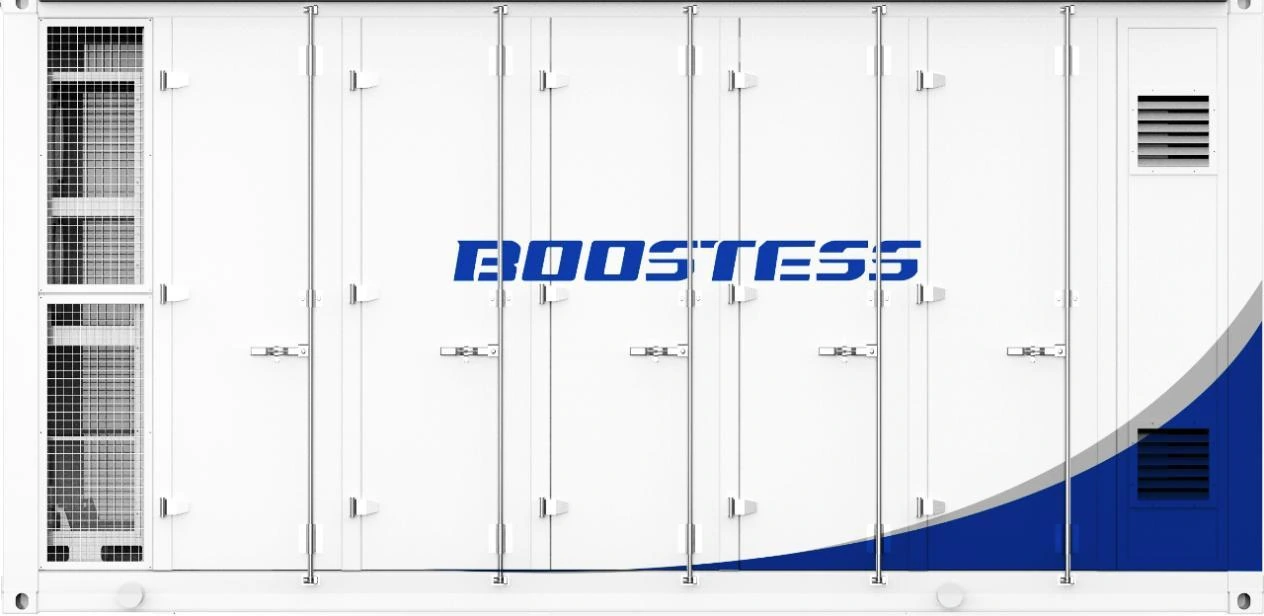
A useful augmentation plan connects capacity projections with physical space, electrical limits, approved interfaces, downtime and procurement responsibility. The containerized storage platform and modular high-voltage racks illustrate two scales of equipment. Neither makes future additions automatic. Expansion still needs a design compatible with the original installation.
Key takeaways
- State future energy requirements at a defined measurement boundary.
- Compare planned augmentation with operating a smaller usable capacity.
- Reserve interfaces and service access, as well as physical space.
On this page
- Define the capacity that actually matters
- Separate calendar aging from cycling
- Compare three lifecycle choices
- Build a transparent illustrative calculation
- Reserve more than empty ground
- Check compatibility before mixing equipment
- Put downtime and retesting into the budget
- Use a trigger with a defined evidence chain
- Questions about future battery additions
- Make the first installation ready for its lifecycle
Define the capacity that actually matters
An augmentation decision needs a usable-energy target. Nominal battery capacity identifies a product, but the project may depend on energy delivered to an AC connection within a specified period. Allowed SOC limits, discharge power, auxiliary demand and operating conditions influence that delivery.
Start with the owner’s obligation. It may be an agreed backup period, a dispatch commitment or a recurring load-management window. Write that requirement in measurable terms. Include the delivery point, operating power, reserve policy and the conditions under which performance is checked. Without these terms, a capacity forecast can look precise while answering the wrong question.
The DOE BESS evaluation method uses metered charge and discharge data to assess deployed-system performance. For planning, that supports a simple discipline: keep the contractual energy boundary consistent with the monitoring boundary. A forecast in battery-side DC energy should not silently become a promise of the same energy at the site AC meter.
Separate calendar aging from cycling
A battery can lose available capacity with time and use. A project that cycles frequently has a different duty profile from one held mostly for backup. Storage conditions, temperature and SOC policy also need to be represented in the supplier’s model.
SAM’s battery-life documentation distinguishes calendar and cycle degradation and provides different replacement options. The useful lesson for procurement is the distinction, not a particular software default. Model settings must match the offered chemistry and the supplier’s evidence. A default curve is not a measurement of the equipment being purchased.
Request a degradation projection for the proposed duty profile and ask how its uncertainty is handled. Identify whether the projection is a design assumption, a warranted retention schedule or a tested result. Those categories carry different commitments. A long cycle-life number cannot replace a project forecast that accounts for time, dispatch intensity and the required operating range.
Compare three lifecycle choices
The owner can accept declining usable energy, install extra capacity at the start, or plan later augmentation. The choice should follow the project’s obligation and economics rather than an assumption that one method always wins.
Accepting decline can be reasonable when the original capacity has ample margin and the remaining energy still serves the task. Initial oversizing avoids a later installation event, but ties up capital and may require additional space or equipment from the beginning. Later augmentation can delay expenditure while creating future engineering, supply-chain and outage responsibilities.
The 2025 NLR utility-scale battery storage baseline explicitly models storage cost and performance assumptions for planning. Use such references to understand cost categories, not to assign a vendor’s future price. The project model needs its own installed cost, financing assumptions, O&M scope and service schedule. A forecast reduction in battery prices does not remove installation or integration costs.
Build a transparent illustrative calculation
Consider a hypothetical project with a contractual requirement for 800kWh at its defined delivery point. Assume its model forecasts 1,000kWh initially, 850kWh at a later review and 780kWh at the following review. These are illustrative planning values, not measured product performance.
The first review still shows a 50kWh margin. The next shows a 20kWh shortfall. That shortfall identifies the need for action, but it does not specify a 20kWh purchase. Any replacement or addition must fit approved module sizes, usable-energy limits and electrical interfaces. Installation downtime and the post-work acceptance test also affect the practical solution.
| Illustrative review | Forecast delivered energy | Margin against 800kWh |
|---|---|---|
| Initial acceptance | 1,000kWh | +200kWh |
| Intermediate review | 850kWh | +50kWh |
| Later review | 780kWh | -20kWh |
Add uncertainty around the forecast before choosing the intervention date. Waiting for the first measured shortfall may be inappropriate when a new module has a long procurement lead time or the site has a narrow installation window. The trigger should allow enough time for evidence review, ordering and approved work.
The supplied 5MWh system lists 5,015kWh nominal energy and an associated 2,500kW PCS rating. Their ratio is approximately 2.01 nominal hours, before usable-energy limits and system losses. Adding battery capacity while retaining that PCS changes the energy-to-power relationship; it does not raise the PCS rating. The supplied 261kWh indoor rack is another configuration, composed of thirteen series packs. Its series architecture means an expansion proposal must distinguish an approved additional rack from a change within a string. Those real configuration details determine which future intervention is technically available.
Reserve more than empty ground
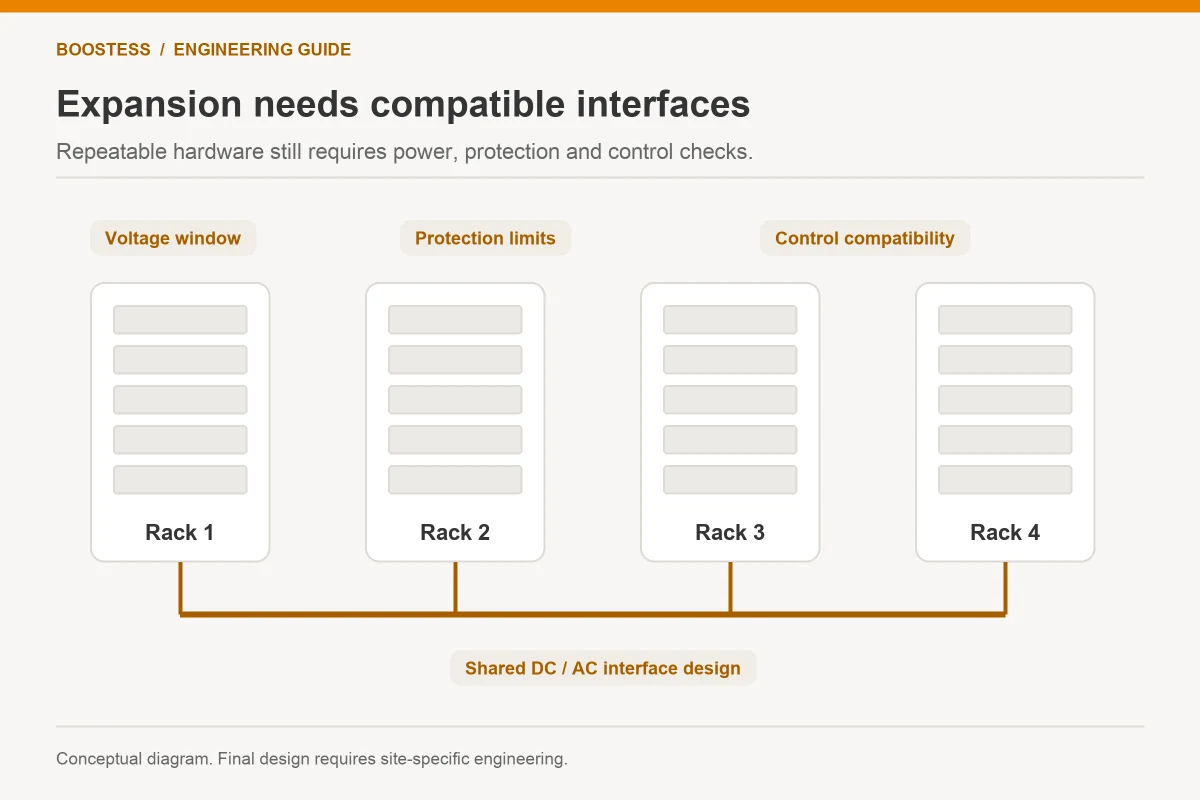
A future battery location is useful only if the existing project can connect and control the new equipment. Review DC and AC interfaces, transformer headroom, protection coordination, communications, cooling support and cable routes. Capacity addition must be compatible with the system design.
Ask whether the original PCS can use the added energy within the required dispatch window. More battery kWh does not automatically increase AC power. Conversely, adding another PCS can change the site’s connected power and bring different connection, protection or permitting questions. The electrical designer should define which expansion paths remain available.
Also preserve serviceability. Spare floor space behind an existing unit may be unusable if the new equipment cannot be delivered or maintained there. The expansion drawing should show installation access while the original project remains in service, or identify the shutdown required. Treat the proposed future equipment arrangement as a design scenario rather than a blank rectangle labelled “phase two.”
Check compatibility before mixing equipment
Do not assume a later pack can be added directly to an older string. Battery configuration, voltage, firmware, current limits and protection behavior need an approved compatibility review. Differences in age and available capacity can also affect how the combined arrangement performs.
A written interface decision should identify the acceptable replacement or expansion parts, supported software revisions and any restrictions on operation. Ask who will maintain that information if a supplier changes a cell, pack or controller during the project life. The installed record needs enough detail to distinguish the original configuration from a later revision.
Some projects may favor adding a separately controlled block rather than altering an existing battery string. Others may have an approved replacement strategy. The correct method depends on the product and project design. A general blog cannot establish compatibility or authorize service work. The value of early planning is to make the future approval route and technical responsibility clear.
Put downtime and retesting into the budget
Augmentation has a period when equipment is unavailable or restricted. Define what the site must do during that period, including backup arrangements, dispatch commitments and work-zone access. The project’s lifecycle cost should include the resulting operational consequences.
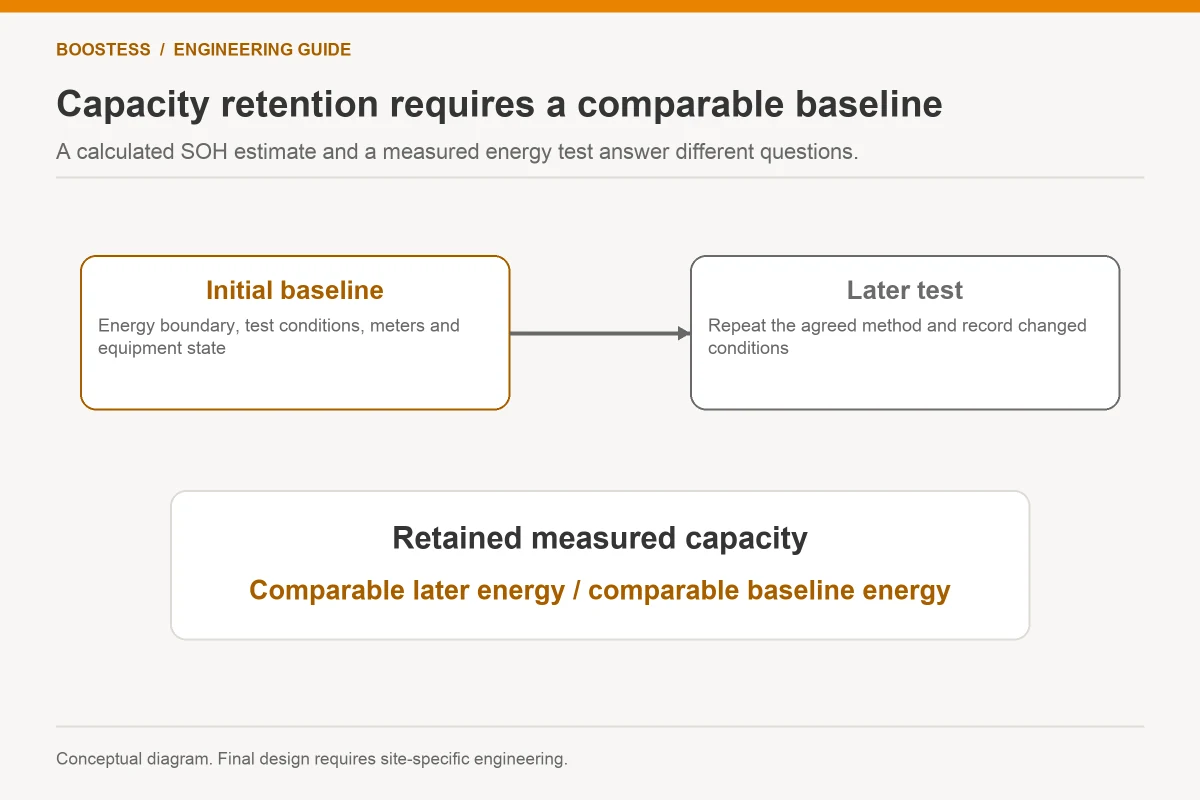
The work package also needs post-installation verification. Specify how the modified configuration will be checked for communications, controls, protections and delivered energy. Establish whether the original performance baseline remains valid or a new baseline is required. A new pack serial number and an updated asset list are only part of the handover.
Budget for engineering, freight, handling, site work, tests and record updates alongside the equipment. Avoid describing augmentation as a future battery purchase alone. Where the work involves an external integrator, state who is responsible for proving that the revised system meets the agreed requirement. A division of supply contracts should not leave that proof unassigned.
Use a trigger with a defined evidence chain
The intervention trigger should tell the operator when to start a review and what evidence is required. A monitored SOH estimate can flag a change, while an agreed capacity test can provide a different form of evidence. The two should not be treated as interchangeable without a documented method.
A practical process is to review the operating record, check whether dispatch has stayed within the agreed assumptions, assess the latest energy forecast and confirm supplier lead time. If the margin approaches the project’s action threshold, the responsible engineer can evaluate the approved options. The owner then has a decision supported by operating information rather than a surprise shortfall.
Keep this process in the O&M scope. Name the party that reviews capacity, the party that approves modifications and the party that carries the purchase cost. If the performance obligation sits in one contract while augmentation costs sit in another, resolve the relationship before signing.
Questions about future battery additions
Does augmentation always mean more containers?
No. It can involve approved replacement, additional modules or a separately controlled block. The options depend on the equipment interfaces, available space and required energy or power. Compare them through the project design.
Can a cycle-life claim establish the augmentation year?
No. It needs the associated test conditions, operating profile and capacity-retention basis. Calendar aging and project dispatch matter too. Use a model-specific lifecycle projection and the actual contract terms.
Should future energy be guaranteed at the battery or site meter?
Use the boundary that represents the project’s obligation, then keep the test and monitoring method consistent with it. If the agreement uses AC delivery, include the agreed losses and auxiliaries in that definition.
Make the first installation ready for its lifecycle
An effective augmentation plan specifies the future energy obligation, a transparent forecast, an approved intervention route and the resources needed to carry it out. Revisit the plan as operating data becomes available. Avoid promising that today’s equipment can accept tomorrow’s unspecified battery.
The system integration scope can help frame the supplier discussion. For a project-specific assessment, send BOOSTESS the duty profile, required retained energy and proposed expansion space through a technical inquiry. Ask for a documented lifecycle arrangement alongside the opening-year equipment selection.